
Tech
Best Ways to Learn Math: A Practical Guide for Students and Lifelong Learners

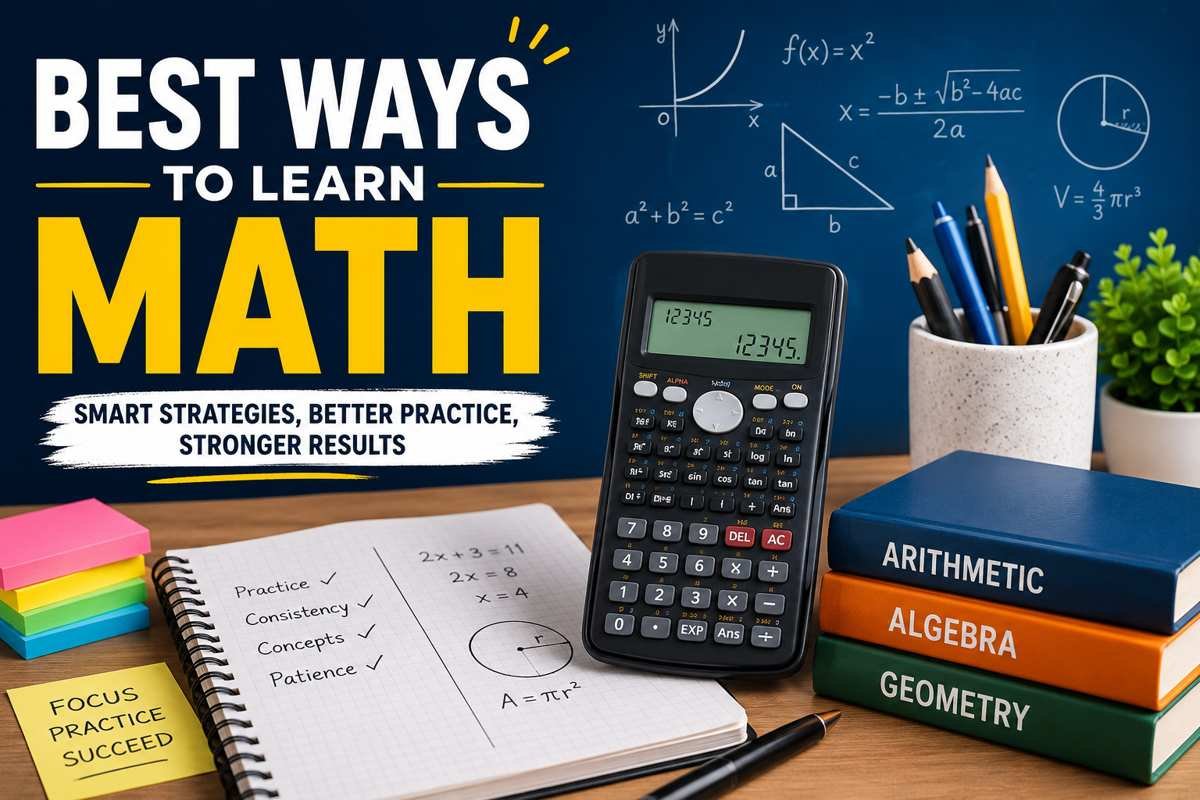
Math is one of the most important skills people use in daily life, yet many students struggle to feel confident with it. Some believe math is only for people who are naturally gifted, while others think they are simply “bad at math.” The truth is that anyone can improve with the right methods, consistency, and mindset.
Learning math is not about memorizing endless formulas. It is about understanding patterns, solving problems step by step, and practicing regularly. Whether you are a school student, college learner, or someone trying to improve basic math skills, using the right learning strategies can make a huge difference.
In this article, you will discover the best ways to learn math effectively, improve problem-solving skills, and build long-term confidence.
Understand the Basics Before Moving Forward
One of the biggest reasons students struggle with math is skipping foundational concepts. Math works like a staircase. If one step is weak, the next step becomes difficult.
For example, algebra becomes confusing without a strong understanding of fractions and basic arithmetic. Geometry becomes harder when basic formulas are unclear.
Instead of rushing into advanced topics, spend time strengthening the basics:
- Addition and subtraction
- Multiplication and division
- Fractions and decimals
- Percentages
- Basic algebra concepts
When your foundation is strong, advanced topics become easier to understand.
Practice Math Every Day
Consistent practice is one of the best ways to improve math skills. Unlike subjects that rely heavily on reading, math requires active problem-solving.
Even 20 to 30 minutes of daily practice can improve understanding and speed. Solving problems regularly helps your brain recognize patterns and remember methods naturally.
A good daily math routine may include:
- Reviewing old concepts
- Solving new problems
- Checking mistakes
- Practicing weak areas
Daily repetition builds confidence and reduces fear of difficult questions.
Focus on Understanding Instead of Memorizing
Many students try to memorize formulas without understanding how they work. This creates problems during exams because even a small change in the question becomes confusing.
Instead of memorizing blindly, ask questions like:
- Why does this formula work?
- What does this equation represent?
- How is this method connected to previous concepts?
For example, understanding why the area of a triangle formula works is more useful than memorizing it without context.
When you truly understand concepts, solving unfamiliar problems becomes much easier.
Learn Through Step-by-Step Problem Solving
Breaking problems into smaller steps is one of the most effective learning methods.
Complex math questions often look intimidating at first glance. However, most difficult problems become manageable when divided into smaller parts.
Here is a simple approach:
- Read the problem carefully
- Identify what is given
- Determine what needs to be solved
- Choose the correct method
- Solve step by step
- Review the final answer
This process improves logical thinking and prevents careless mistakes.
Use Visual Learning Techniques
Visual learning can make math easier and more interesting.
Graphs, diagrams, charts, and number lines help students understand concepts more clearly. Geometry, algebra, and statistics especially become easier through visual representation.
Some useful visual tools include:
- Colored notes
- Mind maps
- Graph paper
- Educational videos
- Interactive math apps
Visual learning helps the brain process information faster and improves memory retention.
Solve Real-Life Math Problems
Applying math to daily life makes learning more meaningful.
When students see how math works in real situations, they often become more motivated. Real-world applications help remove the feeling that math is only for classrooms.
Examples include:
- Calculating shopping discounts
- Measuring ingredients while cooking
- Managing savings and budgets
- Tracking sports statistics
- Calculating travel time and distance
Using practical examples improves understanding and shows the importance of mathematical thinking.
Learn From Mistakes Instead of Avoiding Them
Mistakes are a natural part of learning math.
Many students become discouraged after getting wrong answers, but errors actually provide valuable learning opportunities. Reviewing mistakes helps identify weak areas and prevents repeating them.
Whenever you make an error:
- Find where the mistake happened
- Understand why it happened
- Practice similar questions
- Correct the method
Students who analyze mistakes carefully often improve faster than those who only focus on correct answers.
Develop Strong Problem-Solving Habits
Strong problem-solving skills are essential for mastering math.
Instead of immediately looking at solutions, spend time thinking through problems independently. Even if the answer is incorrect, the thinking process improves analytical ability.
Helpful habits include:
- Writing down each step clearly
- Double-checking calculations
- Practicing word problems
- Trying different solution methods
- Working without distractions
These habits improve both accuracy and confidence.
Use Online Resources Wisely
The internet offers excellent learning tools for students who want to improve their math skills.
Online resources can explain difficult topics in different ways, making concepts easier to understand.
Some useful resources include:
- Educational YouTube channels
- Interactive math websites
- Practice worksheets
- Online quizzes
- Virtual tutoring platforms
However, avoid relying only on watching videos. Real improvement comes from actively solving problems yourself.
Study in Short and Focused Sessions
Long study hours do not always produce better results.
Short and focused sessions are often more effective because the brain stays alert and engaged.
A useful method is the 25–5 study technique:
- Study math for 25 minutes
- Take a 5-minute break
- Repeat the cycle
This approach improves concentration and reduces mental fatigue.
Build Confidence Gradually
Confidence plays a major role in math performance.
Students who constantly believe they are bad at math often avoid practicing, which creates even more difficulty.
Start with easier problems and slowly move toward advanced questions. Small achievements build momentum and motivation.
Positive habits include:
- Celebrating progress
- Practicing regularly
- Avoiding negative self-talk
- Asking questions when confused
- Staying patient during difficult topics
Confidence grows over time through consistent effort.
Study With Friends or Groups
Group learning can improve understanding and motivation.
Discussing problems with classmates helps students learn different solving methods and perspectives.
Benefits of study groups include:
- Sharing ideas
- Solving difficult questions together
- Staying motivated
- Learning faster through discussion
- Improving communication skills
However, choose focused study partners who are serious about learning.
Keep Notes and Formula Sheets
Organized notes make revision easier and save time during exam preparation.
Create a dedicated notebook for:
- Important formulas
- Example problems
- Common mistakes
- Quick shortcuts
- Key concepts
Reviewing notes regularly strengthens memory and improves exam performance.
Improve Mental Math Skills
Mental math helps students solve problems faster and improves overall number sense.
Simple exercises can strengthen mental calculation ability:
- Multiplication practice
- Quick percentage calculations
- Estimation exercises
- Addition and subtraction drills
Mental math is especially useful during exams and real-life situations.
Stay Consistent Instead of Studying Only Before Exams
Last-minute studying often creates stress and weak understanding.
Math is best learned through steady and continuous practice over time. Consistency allows the brain to absorb concepts naturally.
Students who study regularly usually:
- Remember formulas longer
- Solve problems faster
- Feel less exam anxiety
- Perform better academically
Small daily effort is more effective than long cramming sessions.
Ask for Help When Needed
There is nothing wrong with asking questions.
Many students stay confused because they feel embarrassed to ask teachers, tutors, or classmates for help.
If a topic feels difficult:
- Ask your teacher for clarification
- Watch another explanation online
- Use practice examples
- Hire a tutor if necessary
- Discuss problems with classmates
Seeking help early prevents confusion from growing.
Simple Math Study Time Calculator
Tracking your study time can help improve consistency and discipline while learning math. Use this simple calculator formula to measure your weekly math practice.
Study Time Calculator Formula
Weekly Math Study Hours = (Daily Study Minutes × Days Practiced Per Week) ÷ 60
Example Calculation
| Daily Study Minutes | Days Practiced | Total Weekly Hours |
|---|---|---|
| 30 Minutes | 5 Days | 2.5 Hours |
| 45 Minutes | 6 Days | 4.5 Hours |
| 60 Minutes | 7 Days | 7 Hours |
How to Use This Calculator
- Write down how many minutes you study math daily.
- Multiply it by the number of days you practice each week.
- Divide the answer by 60 to convert minutes into hours.
Quick Example
If you study math for 40 minutes daily and practice 6 days a week:
40 × 6 = 240 minutes
240 ÷ 60 = 4 hours per week
This simple method helps students track progress and maintain a consistent study routine for better results in math.
Why Patience Matters in Learning Math
Math improvement rarely happens overnight.
Some topics may take days or weeks to fully understand, and that is completely normal. The important thing is to continue practicing instead of giving up.
Patience helps students:
- Stay motivated
- Handle difficult topics calmly
- Learn from mistakes
- Develop long-term understanding
The more time and effort you invest, the stronger your skills become.
Conclusion
Learning math becomes easier when students focus on understanding, practice consistently, and build strong problem-solving habits. Success in math is not limited to naturally gifted learners. With the right approach, anyone can improve.
The best ways to learn math involve strengthening fundamentals, practicing daily, learning from mistakes, using visual methods, and staying patient throughout the process.
Math is not just about solving equations. It develops logical thinking, improves decision-making, and helps in everyday life. The more actively you practice, the more confident and skilled you become.
More Details : 10 Best Books for Time Management to Improve Productivity and Focus in Daily Life
FAQs
1. What is the fastest way to improve math skills?
The fastest way is consistent daily practice combined with understanding concepts instead of memorizing formulas.
2. How many hours should I study math daily?
Even 20 to 30 minutes of focused practice daily can improve math performance significantly.
3. Why do students find math difficult?
Many students struggle because they skip basic concepts, avoid practice, or rely too much on memorization.
4. Can adults improve their math skills?
Yes, adults can improve math skills through regular practice, online resources, and step-by-step learning.
5. Are online math resources helpful?
Yes, online videos, quizzes, and interactive tools can make learning easier when combined with active problem-solving practice.

12 Best Omegle Alternatives for Random Video Chat and Meeting New People

Dbxbqm Meaning: Why It Appears When You Try to Type YouTube

Immediate Loading Implants: How “Fixed Teeth in 48 Hours” Really Works

How UK Mobile Proxies Help Businesses Test Their Websites

Gen AI in Supply Chain: Using Supply Chain Benchmarks to Improve Performance

What Is the UK Theory Test? How It Works, Cost and Pass Mark

Weather the Storm: Why Totally Branded Umbrellas are the UK’s Most Appreciated Gift

How to Store, Wind, and Travel With Your Automatic Watch Collection Without Damaging It

What Do HubSpot Onboarding Services Include?

AI in Supply Chain: How AI Consulting Services Help Build More Intelligent and Resilient Operations
Immediate Loading Implants: How “Fixed Teeth in 48 Hours” Really Works
How UK Mobile Proxies Help Businesses Test Their Websites
Gen AI in Supply Chain: Using Supply Chain Benchmarks to Improve Performance
12 Best Omegle Alternatives for Random Video Chat and Meeting New People
Dbxbqm Meaning: Why It Appears When You Try to Type YouTube
12 Best Omegle Alternatives for Random Video Chat and Meeting New People
Dbxbqm Meaning: Why It Appears When You Try to Type YouTube
Immediate Loading Implants: How “Fixed Teeth in 48 Hours” Really Works
How UK Mobile Proxies Help Businesses Test Their Websites
Gen AI in Supply Chain: Using Supply Chain Benchmarks to Improve Performance
What Is the UK Theory Test? How It Works, Cost and Pass Mark
Weather the Storm: Why Totally Branded Umbrellas are the UK’s Most Appreciated Gift
How to Store, Wind, and Travel With Your Automatic Watch Collection Without Damaging It
What Do HubSpot Onboarding Services Include?
AI in Supply Chain: How AI Consulting Services Help Build More Intelligent and Resilient Operations
-

 Tech9 months ago
xxx is equal to 2022: A Complete Informative Explanation of a Cubic Equation
-

 Celebrity8 months ago
Izzie Balmer Partner: A Deep Dive into the Relationship with Will Hawley
-

 Entertainment9 months ago
The Artistic World of Gege Akutami: A Mastermind Behind Jujutsu Kaisen
-

 Food5 months ago
Best Sushi Rice Brands: A Complete Guide to Choosing the Right Rice for Sushi