
Tech
Understanding Tree in Data Structure: A Complete Guide

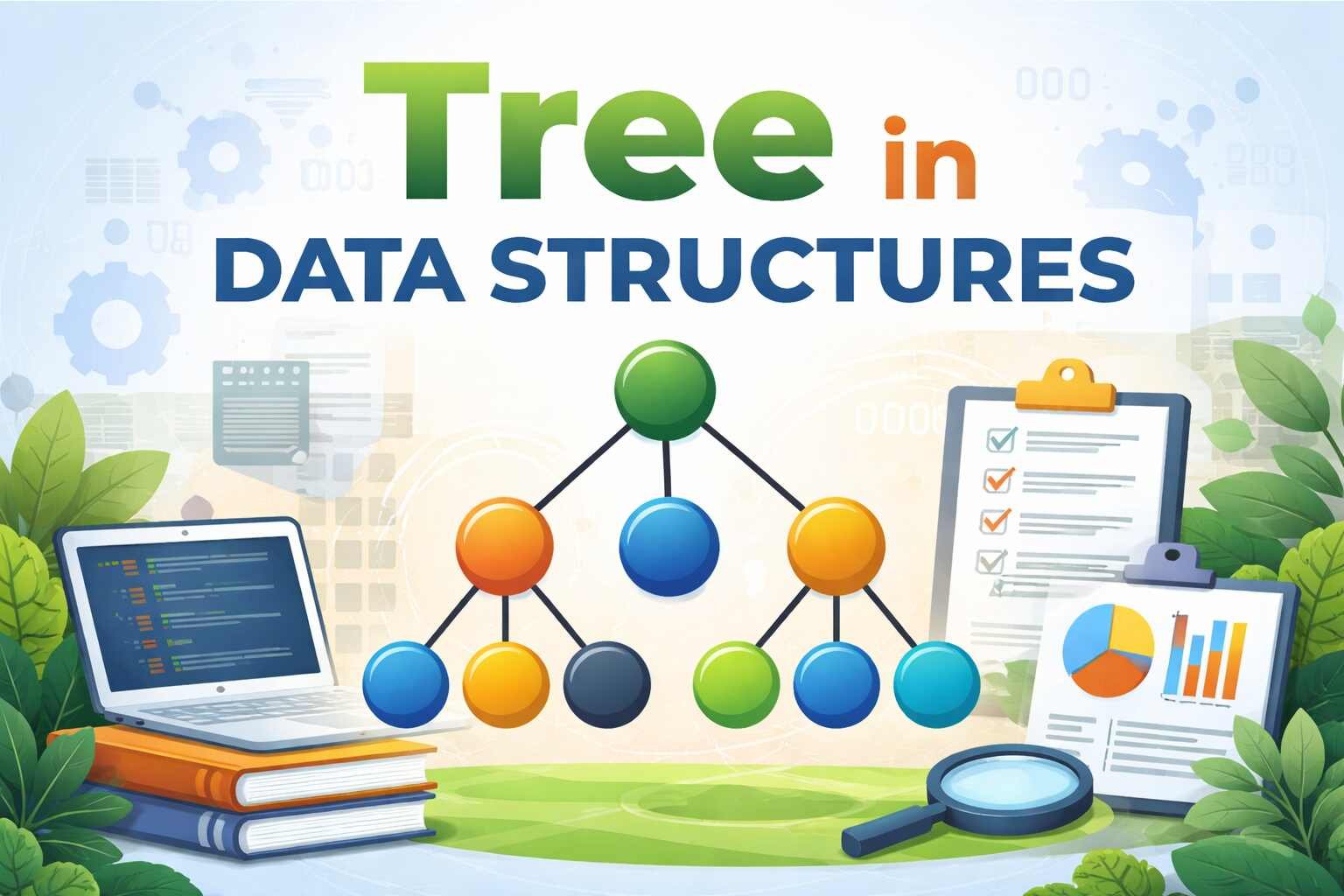
A tree in data structure is one of the most important and widely used abstract data types in computer science. Unlike linear structures such as arrays, linked lists, stacks, or queues, a tree organizes data hierarchically. This means each element, called a node, can have zero or more child nodes, forming a branching structure. Trees are used in many applications like file systems, databases, network routing, and more. Understanding how trees work is crucial for any programmer, especially in Java and other object-oriented languages.
Basic Terminology of Tree
To work with trees effectively, you must understand the basic terms:
- Node: The fundamental unit of a tree. It stores data.
- Root: The topmost node of the tree. There is only one root in a tree.
- Child: A node that descends from another node.
- Parent: A node that has one or more children.
- Leaf: A node that does not have any children.
- Sibling: Nodes that share the same parent.
- Height of Tree: The length of the longest path from the root to a leaf.
- Depth of Node: Distance from the root node to a particular node.
These terms form the foundation of tree concepts and are used throughout different tree operations and algorithms.
Types of Trees in Data Structures
There are several types of trees, each serving specific purposes:
- Binary Tree
A binary tree is a tree where each node has at most two children, usually referred to as left and right child. Binary trees are the simplest form of hierarchical data structures and form the basis of more advanced trees. - Binary Search Tree (BST)
In a BST, for any node, all values in its left subtree are smaller, and all values in the right subtree are larger. This property allows efficient searching, insertion, and deletion operations. - AVL Tree
An AVL tree is a self-balancing binary search tree. After every insertion or deletion, the tree adjusts itself to maintain a balanced height, ensuring O(log n) search time. - Red-Black Tree
A red-black tree is another type of self-balancing binary search tree. It uses color attributes to maintain balance, allowing insertions and deletions without compromising search efficiency. - N-ary Tree
In an N-ary tree, each node can have up to N children. This is common in file systems, where directories can have multiple files and subdirectories. - Trie
Tries, or prefix trees, are used primarily in string-related algorithms. They store sequences like words and allow fast retrieval of data, making them useful in applications such as autocomplete and spell-checkers.
Properties of Tree in Data Structure
Every tree has specific properties that distinguish it from other data structures:
- Hierarchy: Trees store data in a hierarchical structure, unlike linear data structures.
- Rooted Structure: Each tree has a unique root node.
- Connected Nodes: Every node is connected by an edge, which represents a parent-child relationship.
- No Cycles: Trees do not contain cycles. A node cannot point back to an ancestor node.
Understanding these properties helps in designing algorithms for traversal, insertion, and deletion.
Applications of Trees
Trees are versatile and can be applied in various areas:
- File Systems: Operating systems use trees to manage directories and files efficiently.
- Databases: Hierarchical databases and indexing often use tree structures for quick search and retrieval.
- Compiler Design: Syntax trees help in parsing expressions and statements in programming languages.
- Networking: Trees are used in routing algorithms to represent paths and network hierarchies.
- Artificial Intelligence: Decision trees are used in machine learning for classification and regression tasks.
Binary Tree Representation
A binary tree can be represented in two main ways:
- Linked Representation
Each node contains data and pointers to its left and right child. This approach is memory-efficient and dynamic. - Array Representation
Nodes are stored in arrays. The root is stored at index 1. For a node at index i, the left child is at 2i, and the right child is at 2i + 1. This is mostly used for complete binary trees and heaps.
Tree Traversal Techniques
Traversing a tree means visiting all nodes in a specific order. There are two main types:
- Depth-First Traversal (DFS)
DFS explores as far as possible along each branch before backtracking. Types include:- Inorder Traversal: Left → Root → Right
- Preorder Traversal: Root → Left → Right
- Postorder Traversal: Left → Right → Root
- Breadth-First Traversal (BFS)
BFS, or level-order traversal, visits nodes level by level starting from the root.
Traversal is crucial for performing operations like searching, printing, or updating tree data.
Insertion in a Tree
The process of adding a node depends on the type of tree:
- Binary Tree: Insert at the first available position, usually level by level.
- Binary Search Tree: Compare the value with the current node and move left or right recursively until the correct position is found.
- AVL Tree: After insertion, check balance and rotate nodes if necessary to maintain balance.
Efficient insertion ensures that search operations remain fast.
Deletion in a Tree
Deleting a node in a tree can be tricky. Steps vary based on the node’s children:
- Leaf Node: Remove directly.
- Node with One Child: Replace the node with its child.
- Node with Two Children: Find the inorder successor or predecessor, replace the node, and remove the successor/predecessor.
Self-balancing trees may require rotations after deletion to maintain optimal height.
Searching in a Tree
Searching efficiency depends on the tree type:
- Binary Search Tree: O(log n) on average, O(n) in the worst case if unbalanced.
- AVL/Red-Black Tree: Guaranteed O(log n) due to self-balancing.
- Trie: O(k) for searching a string of length k, making it efficient for dictionary applications.
Choosing the correct tree type is important for optimizing search performance.
Advantages of Using Trees
- Hierarchical Representation: Mirrors real-world hierarchical relationships.
- Efficient Search: BSTs and self-balancing trees offer fast lookup.
- Flexible Data Organization: Nodes can have multiple children depending on the type.
- Support for Recursion: Many tree operations can be implemented recursively, simplifying code.
Disadvantages of Using Trees
- Complex Implementation: Especially for self-balancing trees.
- Memory Usage: Pointers in linked representations consume extra memory.
- Maintenance: Rotations and balancing can be computationally intensive.
Understanding pros and cons helps in deciding whether a tree is suitable for a particular application.
Tree in Java
In Java, trees can be implemented using classes and objects. A typical binary tree node class looks like this:
class TreeNode {
    int data;
    TreeNode left, right;    public TreeNode(int data) {
        this.data = data;
        left = right = null;
    }
}
Operations like insertion, deletion, and traversal are implemented using recursive methods. Java provides libraries such as TreeSet and TreeMap, which internally use Red-Black trees to maintain sorted order efficiently.
Real-World Example
Consider a file system on your computer. The root directory contains several folders. Each folder may have files or subfolders. This hierarchical structure is best represented using a tree. Operations like searching for a file, creating a folder, or deleting a file all involve tree operations behind the scenes.
Conclusion
A tree in data structure is a versatile tool for organizing hierarchical data. Understanding its types, properties, and operations is crucial for software development. Trees provide efficient search, insertion, and deletion operations and are used in many real-world applications like file systems, databases, and AI algorithms. Choosing the correct tree type can significantly improve performance and simplify problem-solving.
More Details : 15 Powerful Database Optimization Techniques to Boost Performance
FAQs
Q1: What is the main advantage of using a tree?
Trees provide hierarchical data storage, enabling efficient search, insertion, and deletion operations compared to linear structures.
Q2: What is the difference between a binary tree and a binary search tree?
A binary tree allows any arrangement of nodes with at most two children, while a binary search tree maintains a sorted order, which speeds up searching.
Q3: Why are self-balancing trees used?
Self-balancing trees like AVL or Red-Black trees maintain a balanced height, ensuring search operations stay efficient, O(log n) even in worst-case scenarios.
Q4: Can a tree have cycles?
No, by definition, a tree is acyclic. No node points back to its ancestor.
Q5: What is a leaf node in a tree?
A leaf node is a node with no children, located at the end of a branch.

12 Best Omegle Alternatives for Random Video Chat and Meeting New People

Dbxbqm Meaning: Why It Appears When You Try to Type YouTube

Immediate Loading Implants: How “Fixed Teeth in 48 Hours” Really Works

How UK Mobile Proxies Help Businesses Test Their Websites

Gen AI in Supply Chain: Using Supply Chain Benchmarks to Improve Performance

What Is the UK Theory Test? How It Works, Cost and Pass Mark

Weather the Storm: Why Totally Branded Umbrellas are the UK’s Most Appreciated Gift

How to Store, Wind, and Travel With Your Automatic Watch Collection Without Damaging It

What Do HubSpot Onboarding Services Include?

AI in Supply Chain: How AI Consulting Services Help Build More Intelligent and Resilient Operations
Immediate Loading Implants: How “Fixed Teeth in 48 Hours” Really Works
How UK Mobile Proxies Help Businesses Test Their Websites
Gen AI in Supply Chain: Using Supply Chain Benchmarks to Improve Performance
12 Best Omegle Alternatives for Random Video Chat and Meeting New People
Dbxbqm Meaning: Why It Appears When You Try to Type YouTube
12 Best Omegle Alternatives for Random Video Chat and Meeting New People
Dbxbqm Meaning: Why It Appears When You Try to Type YouTube
Immediate Loading Implants: How “Fixed Teeth in 48 Hours” Really Works
How UK Mobile Proxies Help Businesses Test Their Websites
Gen AI in Supply Chain: Using Supply Chain Benchmarks to Improve Performance
What Is the UK Theory Test? How It Works, Cost and Pass Mark
Weather the Storm: Why Totally Branded Umbrellas are the UK’s Most Appreciated Gift
How to Store, Wind, and Travel With Your Automatic Watch Collection Without Damaging It
What Do HubSpot Onboarding Services Include?
AI in Supply Chain: How AI Consulting Services Help Build More Intelligent and Resilient Operations
-

 Tech9 months ago
xxx is equal to 2022: A Complete Informative Explanation of a Cubic Equation
-

 Celebrity8 months ago
Izzie Balmer Partner: A Deep Dive into the Relationship with Will Hawley
-

 Entertainment9 months ago
The Artistic World of Gege Akutami: A Mastermind Behind Jujutsu Kaisen
-

 Food5 months ago
Best Sushi Rice Brands: A Complete Guide to Choosing the Right Rice for Sushi