Tech
Decision Paralysis? How to Use ‘Statistical Thinking’ to Make Better Life Choices

We have all been there: staring at a restaurant menu for ten minutes, scrolling through Netflix for an hour, or lying awake at 2:00 AM wondering if we should change our career path. This is decision paralysis. It is that frozen feeling where the fear of making the “wrong” choice is so strong that we end up making no choice at all. In a world that offers us infinite options, our brains often short-circuit. We think that by analyzing more data, we will find the perfect answer. However, the secret isn’t more information; it is better processing. By adopting a “statistical” mindset, we can turn overwhelming static into a clear, actionable broadcast.
Life is essentially a series of probabilities, yet we often treat it like a series of certainties. When a student feels overwhelmed by data sets, they might seek statistics assignment help from the experts at myassignmenthelp to ensure their technical analysis is sound. In the same way, we can apply those exact professional analytical methods to our daily lives. Statistical thinking is not about being a human calculator; it is about recognizing that every choice carries a risk and a reward. When we stop looking for a “perfect” 100% guarantee and start looking for the “highest probability of success,” the paralysis begins to lift.
1. The Cost of Doing Nothing: The Statistical Baseline
In the world of data, we often talk about the “Null Hypothesis”—the idea that there is no significant change or effect. In your life, the null hypothesis is staying exactly where you are. Many people believe that by not making a choice, they are avoiding risk. Statistics tells us the opposite. Every second you spend paralyzed is a second of “opportunity cost” that you can never recover.
If you are choosing between two career paths, and you spend six months deciding, you haven’t “saved” yourself from a bad choice. You have effectively lost six months of progress in either direction. Statistical thinking forces you to realize that “no choice” is actually a choice to stay at zero. Once you view time as your most limited data set, the pressure to be perfect is replaced by the pressure to be efficient.
2. Understanding “Expected Value” ($EV$)
One of the most powerful tools in a statistician’s kit is Expected Value. This is a calculation that helps you see the long-term average of a decision if you were to make it a thousand times.
How to Calculate Life’s $EV$
To apply this, you don’t need a complex calculator. You just need to weigh the “Probability of Success” against the “Value of the Reward.”
| Decision Scenario | Probability of Success | Potential Reward (1-10) | Potential Risk (1-10) | Expected Logic |
| Applying for a Dream Job | 20% | 10 (Life-changing) | 2 (Small rejection) | High $EV$ – Go for it! |
| Starting a Side Business | 40% | 8 (Financial freedom) | 5 (Time/Money loss) | Positive $EV$ – Worth the risk. |
| Arguing with a Stranger Online | 5% | 1 (Tiny ego boost) | 9 (Stress/Time loss) | Negative $EV$ – Avoid. |
By using this table-based logic, you can see that even a low-probability event (like a dream job) is worth pursuing if the “Risk” is low. Statistical thinking removes the emotion and shows you where the math actually lands.
3. The 37% Rule: When to Stop Searching
Whether you are looking for the best apartment in London or the best university for your Master’s degree, the “Search Problem” is a major cause of paralysis. How do you know when you’ve seen enough options to make an informed choice?
Mathematicians call this “Optimal Stopping.” If you have a set period to find something (let’s say 11 days to find a flat), you should spend the first 37% of that time (about 4 days) purely exploring. During this phase, you don’t commit to anything; you just gather data. You find out what a “good” flat looks like. After that 37% mark, you commit to the very next option that is better than anything you saw during the exploration phase. This gives you the highest statistical probability of picking the best possible option without wasting infinite time.
4. Signal vs. Noise: Filtering Your Life
We live in an age of information overload. We often think that more “news” or “reviews” will help us decide. But in statistics, more data often just means more “noise.” Noise is the random, irrelevant information that distracts us from the “signal” (the truth).

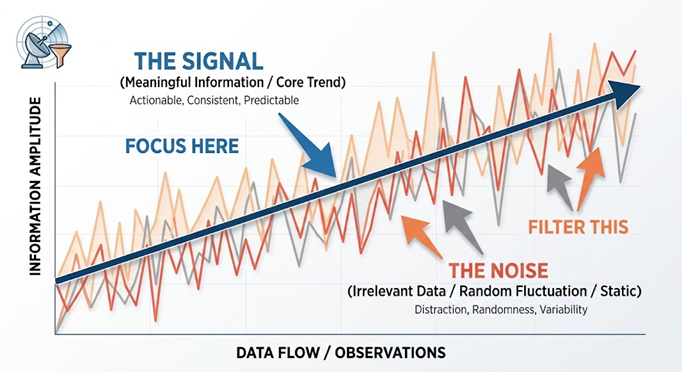
When you are trying to make a big life choice, look for the signal. Ignore the “what ifs” and the opinions of people who aren’t in your field. Focus on the core data: What are your actual skills? What does the market trend look like? What are the historical success rates for this path?
Whether you are trying to interpret a complex scatter plot for a project or trying to organize a massive research paper, a professional assignment maker can help you filter out the noise and find the clear signal. Having a structured approach to data is what separates a successful analyst from someone who is simply overwhelmed.
5. Hypothesis Testing for Your Personal Goals
In a scientific lab, researchers don’t just “hope” for an outcome. They create a hypothesis: “If I do X, then Y will happen.” Then, they run a test. You can apply this “Experimental Design” to your own life to kill paralysis.
Instead of wondering, “Should I move to a new city?” for three years, run a 2-week “Pilot Study.” Rent an Airbnb, work from there, and live like a local. By the end of those two weeks, you will have a small but highly significant data sample. This moves you from “Theoretical Worrying” to “Empirical Evidence.” Statistics proves that a small sample of real-world data is worth more than a mountain of imagination.
6. Sunk Cost Fallacy: The Anchor of the Past
One of the biggest reasons we get stuck is that we feel we have already “invested” too much in our current path to change. This is the Sunk Cost Fallacy. In statistics, “sunk costs” are irrelevant to future decisions.
Imagine you are halfway through a book and you realize it is terrible. Most people finish it because they “already spent 4 hours on it.” A statistical thinker realizes those 4 hours are gone forever regardless of what you do next. The only question that matters is: “Is the next hour better spent finishing this bad book or starting a great one?” Always make decisions based on the future probability of success, not the past history of investment.
7. Regression to the Mean: The Comfort of Averages
Have you ever had a “perfect” week where everything went right, followed by a week where everything crashed? This isn’t bad luck; it’s “Regression to the Mean.” Extreme events (either very good or very bad) are usually followed by more “average” events.
Understanding this prevents you from making radical, paralyzed decisions during a crisis. If you have a terrible day, your statistical brain should tell you: “Statistically, tomorrow is likely to be better because today was an outlier.” This keeps you calm. It stops you from over-correcting your life based on a single bad data point.
8. Bayesian Updating: The Art of Changing Your Mind
Many people think that changing your mind is a sign of weakness. In the world of high-level logic, it is a superpower. “Bayesian Inference” is the process of updating the probability of a hypothesis as more evidence becomes available.
- Start with a “Prior”: I think this career is right for me (70% certainty).
- Get New Data: I did an internship and didn’t enjoy the daily tasks.
- Update your “Posterior”: Now I think this career is right for me (30% certainty).
By constantly “updating” your beliefs based on new experiences, you never stay stuck in a bad decision for long. You become agile. You stop seeing a change of plans as a “failure” and start seeing it as a “data optimization.”
9. Conclusion: The Sample Size of One
The most dangerous statistical error you can make in life is having a “sample size of zero.” You cannot learn, grow, or improve if you don’t take the initial step. Decision paralysis is essentially a refusal to generate data.
When you use statistical thinking, you realize that life isn’t about being right; it’s about being “less wrong” over time. Every choice you make provides a new data point. Even if the choice leads to a “failure,” that failure is high-value data that informs your next move.
Your Action Plan to Beat Paralysis:
- Set a “Stop-Loss”: Give yourself a deadline. “If I haven’t decided by Friday, I will pick option A by default.”
- Quantify the Risk: Put a number (1-10) on the actual danger. Most “scary” decisions are actually a 2 or 3 in terms of real-world risk.
- Focus on the Process, Not the Outcome: In statistics, you can make the “right” move and still get a “bad” result (like a professional poker player losing a hand with Aces). If your process was logical, don’t beat yourself up. Just keep playing the high probabilities.
By viewing your life through the lens of a researcher, you transform from a victim of circumstance into an architect of your own probability. The next time you feel stuck, don’t ask “What is the perfect choice?” Ask “What is the most logical next data point?” Then, move.
Frequently asked questions
1. What exactly is the 37% Rule in decision-making?
This concept suggests that when faced with a set number of options, you should spend the first 37% of your search time exploring without committing. This phase allows you to establish a high-quality benchmark. Once this period passes, you immediately select the next option that surpasses everything you have seen so far, mathematically maximizing your chances of picking the best result.
2. How does statistical thinking help with anxiety?
It shifts the focus from emotional “what-ifs” to objective probabilities. By weighing the actual likelihood of a negative outcome against its real-world impact, you often find that the perceived risk is much higher than the actual danger. This logical approach helps quiet the mind and encourages action over rumination.
3. Why should I ignore “sunk costs” when making a change?
Resources you have already spent—whether time, money, or emotional energy—cannot be recovered regardless of your future path. Decisions should only be based on which choice offers the best potential outcome from this moment forward. Focusing on the past often keeps people trapped in situations that no longer serve their goals.
4. Can I use these methods for small daily choices?
Yes. For minor decisions, you can use a simplified version of Expected Value by asking if the time spent deciding is worth more than the potential benefit. If a choice won’t matter in a year, it is often more “statistically sound” to flip a coin or choose the first viable option to preserve your mental energy for significant life events.
About The Author
Ethan is a lead content strategist at myassignmenthelp, where he focuses on bridging the gap between complex academic theories and practical, real-world applications for students globally. With a background in educational psychology, he is dedicated to creating resources that simplify the learning process and foster long-term academic success.