Tech
How Can Schools Preserve Alumni Achievements in an Interactive Way?

Go to any school’s hallways and there you will see a row of photographs, a dusty trophy case, perhaps a faded gold stenciled class mural on the wall. Such displays can have their appeal, but most students walk by. They do not stop to read the small plaques. They certainly don’t feel a personal connection to the achievements from 30 years ago.
Thus, it is not really the issue of whether schools should preserve alumni accomplishments. Most already try. The key question is: how do you do it in a manner that is relevant to people today?
Why This Matters More Than You Might Think
It’s not just about nostalgia when it comes to alumni recognition. It is genuinely used for a practical purpose. When a student sees that someone else who sat in the same classrooms, walked the same halls and perhaps struggled with the same subjects did something amazing, it changed their outlook. It makes success real and achievable, not abstract.
Beyond student motivation, strong alumni recognition also fosters a strong community spirit. It is a sign to the graduates that their school still cares about them, and that makes a difference in how they engage with their school, how they donate, how they mentor, and how they form long-term relationships with their school. Schools which do this well have more loyal alumni networks who are more involved in it.
The challenge is doing it in a way that makes it feel more alive and not archived.
From the Trophy Case to the Game Field
This was the job for the traditional trophy case, to present physical accomplishment in a physical setting. It lasted for a long time. Today’s students are used to interactive, personal and always up-to-date information. They can’t be kept by a static glass cabinet.
This is where schools can truly think outside the box when it comes to recognition. The change is not the refusal or rejection of tradition, it is about extending it into spaces and formats that feel natural to modern audiences.
The Digital Advantage
A digital hall of fame, a dedicated online space where alumni achievements are documented, categorised and made searchable. It is one of the best ways to do this. Unlike physical displays, digital archives do not have to worry about space on the wall. It can feature:
- Pictures and video
- Written profiles
- Direct links to an alum’s current job or organization
If a student is interested in a career in medicine, architecture, or music, they can search and locate actual students from their school that pursued those careers. It is difficult to duplicate such a particular and private connection with a plaque.
Making It Interactive, Not Just Digital
There is an important difference between “digital” and “interactive”. Just scanning old photos and uploading them onto a website is digital. Interactive means the ability for people to interact with the content, contributing to the content, exploring it and feeling something when they do.
Modern Implementation

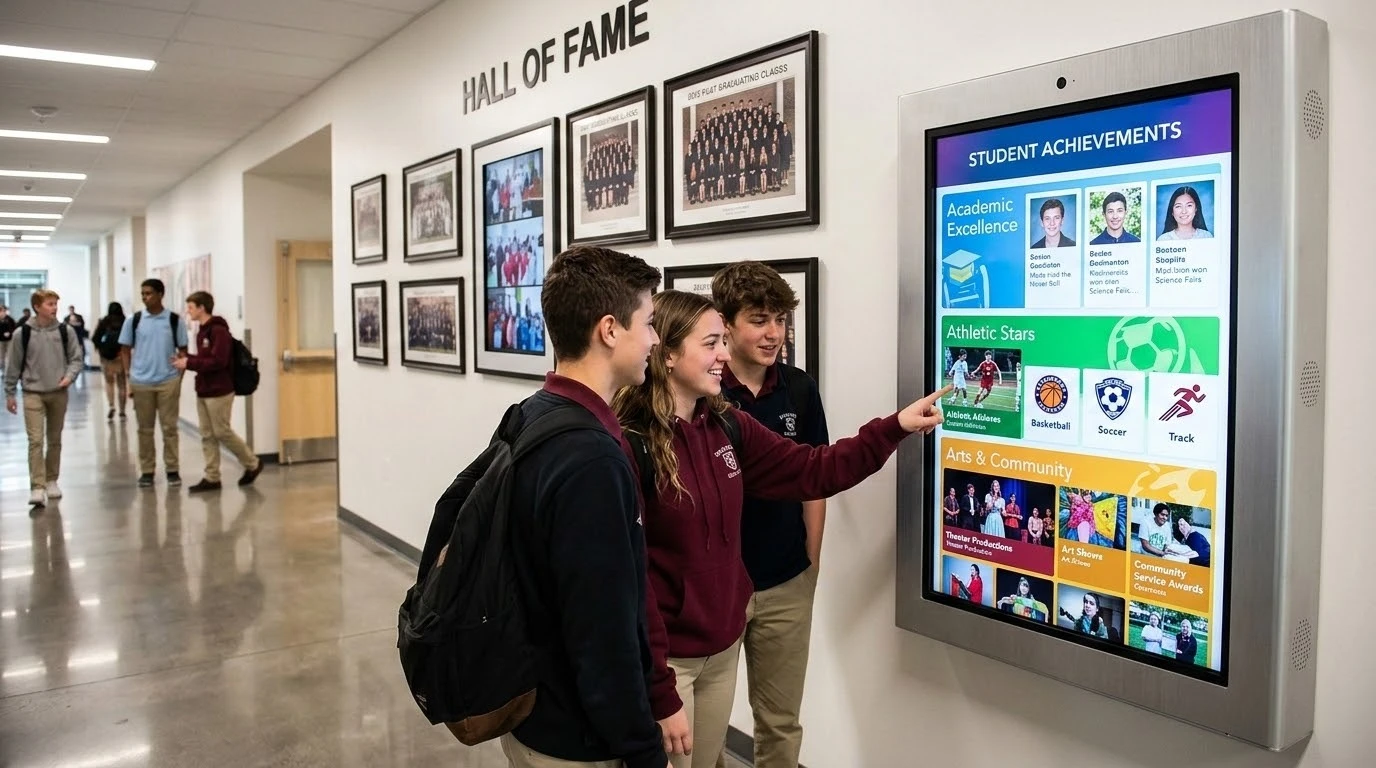
In some schools, making a touchscreen installation in common areas has been successful. Students can explore alumni profiles, view mini-documentary type videos or leave comments. Some have created websites for alumni to sign in and edit their own information, including new achievements as they advance in their career. This makes the archive more of a living document than a historical artifact.
Another layer worth considering is integration with social media. A school’s recognition platform can receive the information of a notable alum’s new accomplishment, whether it’s a book deal, a championship or a business launch. It keeps content fresh and provides current students with an updated view of where graduates are going.
For in-person environments, having a digital hall of fame display in your school lobby or library can be a useful tool for recognition, as well as a conversation starter. These interactive screens can showcase featured alumni, upcoming reunions, and even encourage visitors to nominate someone who deserves recognition. It’s an installation where people look and stop and sometimes say “I went to school with them.”
Getting Alumni Involved
One thing that sometimes gets lost on schools is that their own alumni may be the best source of content. They know the story, they have the pictures, they have the context. There are many people who are truly happy to give, if they are asked appropriately.
Methods of Outreach
Structured outreach (via newsletters, reunions or even a submission form on the school’s website) can actually produce a lot of content. This can be done well in a short interview format with a few questions regarding:
- What they have been doing since leaving school
- What they remember about their school days
- What advice they have for current students
These short profiles are readable, relatable, and require minimal editing.
Some schools go even further, and have an annual event called an “Alumni Spotlight,” where alumni return to speak, answer questions and receive a formal recognition. Pairing that in-person event with digital documentation creates a richer, more lasting record than either approach alone.
Keeping It Inclusive and Diverse
One thing to be intentional about: Recognition programs have a tendency of recognising the loudest of success stories, the professional athletes, the Fortune 500 executives and the elected officials. All those are good accomplishments, but they are not the whole picture.
After 20 years of transforming young minds, a teacher deserves to be honored. So does community organizer, the entrepreneur who created something small but important or someone who quietly raised an exceptional family, while contributing to their neighborhood. Broadening the scope of achievement adds to the richness of the archive, while also bringing the possibility that more students would feel they could one day be part of it.
A Few Practical Starting Points
So if you’re wondering where to start, here are some steps you can take:
- Conduct a “check-up” on what you have. Often, yearbooks, old newsletters, trophy cases and faculty memories are goldmines of unarchived history.
- Select a platform that allows updates. A static pdf will not be as effective as a full database or even a web-based platform where people can contribute over time.
- Involve students in building it. The project involves interviewing alumni, creating displays or running a digital platform, if led by a student to help them gain real skills and personal investment in the result.
- Begin slow and build up. You do not have to take a record of all graduating classes at once. Start from one period of time, or one type of accomplishment and work up.
Closing Thoughts
Preserving alumni achievement is not about looking back, it’s about creating a bridge between the past and the future of a school’s students. When done thoughtfully, it creates a sense of continuity, a source of inspiration and a community that sticks together long after graduation day.
Interactive tools for doing this are more readily available than ever before. As always, the trickier part is in the intention behind the effort, ensuring that the recognition is personal and inclusive and not done out of a duty.Get that right, and the trophy case in the hallway could finally have some worthy company.