Lifestyle
How Indian Citizens Can Register a Marriage in the UAE: A Complete 2026 Guide

For many Indian couples living in Dubai or Abu Dhabi, getting married locally seems like a logical choice. You live and work here, your friends are here. However, in practice, “logical” doesn’t always mean “simple.” In 2026, the procedure has gained new digital requirements but has retained its defining feature – bureaucratic complexity.
Despite digitalization and new laws, the marriage registration process in the UAE for Indian citizens remains a serious test of endurance. It’s not just a matter of “show up and sign the papers,” but rather a multi-week (and sometimes multi-month) marathon involving document collection in two countries, mandatory medical tests, and government fees.
In this article, we will take a detailed look at what you will need to go through, and why, in 2026, more and more couples are choosing to save their nerves by opting for an alternative route.
Marriage Options Available to Indian Citizens in the UAE
In recent years, the legislation of the United Arab Emirates has made significant strides toward accommodating expatriates. Laws have become more liberal, and procedures more secular, theoretically allowing foreigners (including Indian citizens) to register their marriages in the country without mandatory adherence to religious norms.
However, behind this “liberalization” lies a rigid bureaucratic structure. While there are now more options, each comes with a host of conditions: from your religion and type of visa to the requirement of publishing announcements in foreign newspapers. Choosing the right path is not just a formality – it’s a strategic decision that will determine how many months you will spend waiting for that coveted document.
Marriage Registration at the Indian Consulate (Foreign Marriage Act, 1969)
For many Indian couples, registering a marriage through the Consulate (in Dubai) or the Embassy (in Abu Dhabi) seems like the most reliable route, as the marriage is conducted directly under Indian law. However, in practice, this is the longest and most bureaucratic scenario.
Important Restriction: According to the law, the Indian Consulate is not authorized to register a marriage if either partner is Muslim. In such cases, the couple must approach the local UAE courts (Sharia Court).
How Does the Procedure Work?
The consulate process is strictly regulated and consists of several steps:
- Notice of Intended Marriage: Both partners must appear in person at the consulate to submit their application.
- Publication in Newspapers: This is a mandatory and highly specific step. You must publish a notice of your intention to marry in two newspapers: one in the UAE and one in India (in the state of your permanent residence). This allows any interested party to raise objections to the marriage.
- Waiting Period: At least 31 days must pass from the date of publication. If no objections are raised during this period, you can book a date for registration.
- Final Registration: On the appointed day, the bride and groom must attend with three witnesses and bring the original passports.
Required Documents
Based on official rules, a substantial set of documents is needed:
- Passports: Originals and copies of all significant pages. Important: at least one partner must hold a valid residency visa for the respective emirate.
- Forms and Affidavits: Special registration form (5 copies), individual sworn affidavits from each partner, and a joint declaration specifying place of residence.
- Photographs: Five passport-sized color photos per partner.
- Certificate of Singleness: For new expatriates, this must be attested by the Home Department of the relevant Indian state and apostilled by the MEA (New Delhi). Long-term residents may obtain it via IVS Global.
- For Divorced Individuals: Original court decree fully legalized in India (Home Department + MEA).
- Witnesses: Three UAE residents with original identification documents.
Verdict on This Option:
This is the “gold standard” for obtaining an Indian marriage certificate, but be prepared for a marathon lasting 45–60 days and considerable expenses for newspaper publications and document legalization. If you need to marry quickly, this option can easily become a bureaucratic trap.


Marriage under Sharia Law (Islamic Marriage)
If one or both spouses are Muslim, registration through the Indian Consulate is not possible. In the UAE, the only option in this case is the Sharia Court. This is a legally strict procedure that, in 2026, still maintains its fundamental requirements.
Key Rule: In the UAE, a Muslim woman cannot marry a non-Muslim man. If the bride is Muslim and the groom is Hindu, the marriage will not be registered until he officially converts to Islam. A Muslim man can marry a Christian or Jewish woman, but not a Hindu woman without her conversion to Islam.
Mandatory Conditions:
- Bride’s Guardian (Wali): The presence of the father or a male-line representative (brother, uncle) is mandatory. If the guardian is in India, a power of attorney (POA) must be arranged and attested by the Indian Ministry of External Affairs (MEA) and the UAE embassy – a complex bureaucratic process in itself.
- Witnesses: Two Muslim witnesses with original identification documents are required.
- Mahr: The marriage contract specifies the amount of the bride’s wedding gift, which can be paid immediately or deferred in case of divorce.
- Medical Test: A certificate from a government clinic in the UAE confirming the absence of infectious or genetic diseases is mandatory (valid for 3 months).
Required Documents for Indian Citizens:
- Passports and Visas: At least one participant (including the guardian) must be a UAE resident.
- Birth Certificates: Originals attested by the Indian MEA and UAE MOFA, translated into Arabic.
- Certificate of Singleness: Proof that there are no existing marriages.
- Divorce Decree: If applicable, must be fully legalized internationally.
Procedure:
- Online Application: In 2026, documents are submitted through Ministry of Justice portals or court systems (e.g., Dubai Courts).
- Ceremony (Nikah): The ritual is performed by an official (Ma’zoun) at the court, mosque, or at home.
- Registration: The marriage contract is signed by both parties and entered into the court system.
Verdict on This Option:
The main challenge lies in legalizing the guardian’s documents and Indian certificates. Even a minor error in translation or missing MEA attestation can halt the process. Additionally, the requirement for the guardian’s personal presence often becomes a barrier for couples whose families cannot travel to the UAE or do not approve of the union.
Civil Marriage
This is the most modern option for marriage registration in 2026, introduced by the UAE to simplify the process for non-Muslims. However, despite its apparent simplicity, the procedure is highly dependent on the specific emirate and involves a number of bureaucratic nuances.
1. Abu Dhabi: The Most Liberal Option
The Abu Dhabi Judicial Department (ADJD) is considered the “gold standard” for foreigners:
- Who it’s for: Non-Muslims (Hindus, Christians, Sikhs, etc.). This is the only option available to tourists.
- Pros: No witnesses or guardian consent required.
- Procedure: Online application submission and a short ceremony in English. There is also a “24-hour Express Marriage” option.
2. Dubai: Rules for Residents
In Dubai, the rules are stricter:
- Residency: At least one partner must hold a Dubai emirate visa. Tourists are not allowed to register.
- Witnesses: Unlike Abu Dhabi, the presence of two witnesses is mandatory.
Mandatory Requirements:
- Age: Both partners must be over 21 years old.
- Religion: Only for non-Muslims. If one partner is Muslim, the only option is the Sharia Court.
- Medical Test: In 90% of cases (especially in Dubai), a Premarital Screening certificate from a UAE government clinic is strictly required.
Required Documents for Indian Citizens:
- Passports and Emirates ID.
- Certificate of Singleness: Despite the secular nature of the process, the courts require a document attested in India (MEA) or via IVS Global.
- Divorce Documents: Must go through the full legalization chain: Notary in India → SDM → MEA → UAE Embassy → UAE MOFA.
- Translations: All documents in Hindi or English require official translation into Arabic.
Verdict on This Option:
The main challenge is the long queues. Court appointments are often booked weeks in advance. The cost of an “express” marriage in Abu Dhabi can reach 2,500–3,000 AED, not including testing and translation fees. After the ceremony, the certificate still needs to be legalized at MOFA for recognition in India. For many couples, this turns into a month of traveling between offices and significant expenses.

Is There an Alternative for Indian Citizens?
Looking at the long list of requirements in the UAE, many couples ask themselves: “Isn’t there an easier way?” In 2026, the answer for thousands of Indian expats has been Georgia. While in the Emirates you are busy translating documents into Arabic and waiting for newspaper publications, in Tbilisi you can already receive your marriage certificate.
Why are Indian couples from Dubai and Abu Dhabi increasingly choosing Georgia? Here are the main advantages:
- 24-hour registration: Forget the 30-day waiting period. In Georgia, you can officially get married literally on the day of your arrival.
- Minimal paperwork: You only need your passport and a notarized translation into Georgian. No “Singleness Certificate” from India, no religious affidavits, and no guardian approvals.
- Visa-free entry: For Indian citizens with a UAE residency visa, traveling to Georgia in 2026 remains as simple as possible (often visa-free or via an easy e-visa), and the flight from Dubai takes just 3.5 hours.
- Worldwide recognition: Once legalized, a Georgian marriage certificate is recognized both in the UAE and in India. It’s a completely legal method that allows you to easily apply for a family visa in the Emirates later.
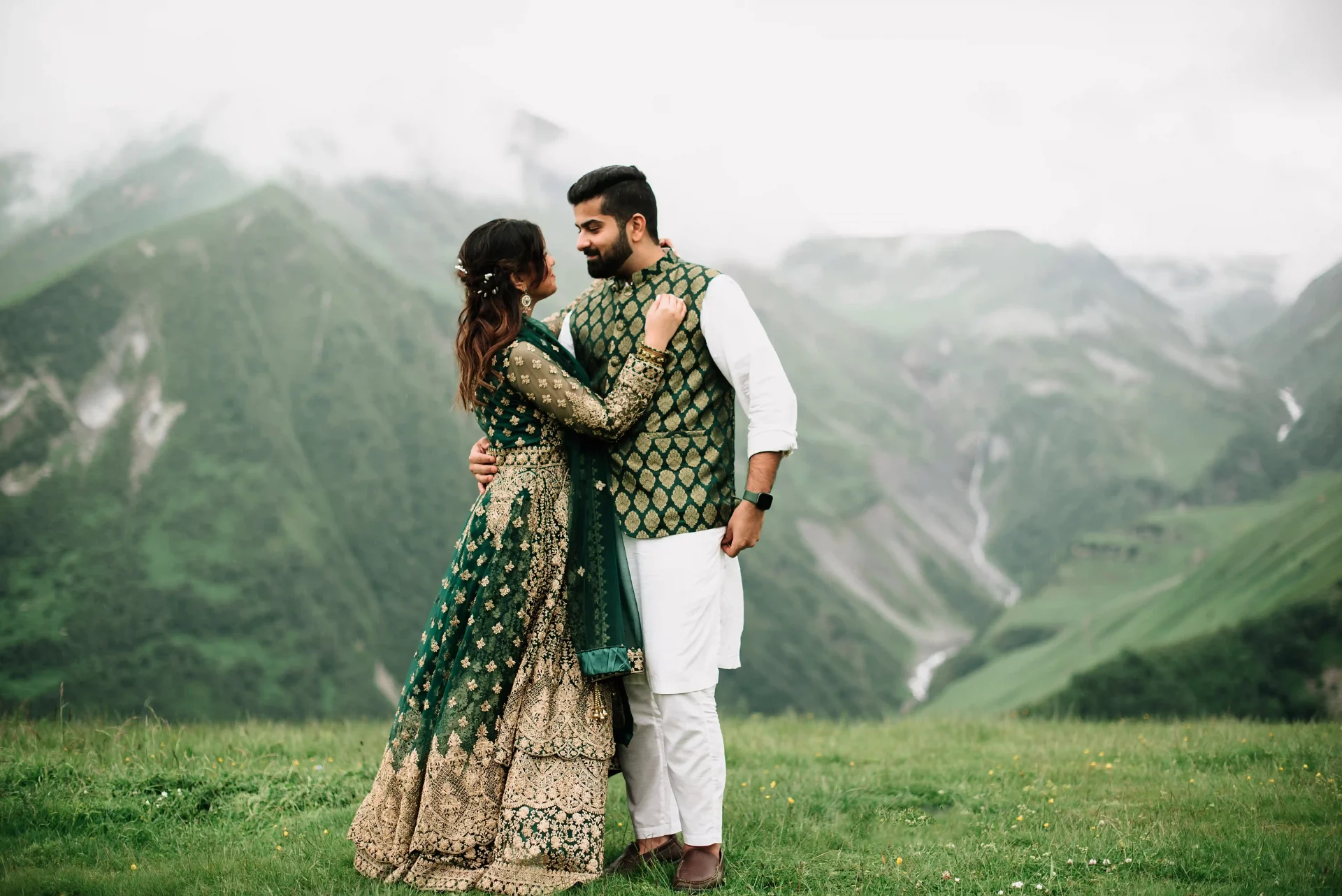
- A wedding as a celebration, not a court visit: Instead of the gray corridors of the Indian consulate, you get a ceremony against the backdrop of the Caucasus Mountains, the vineyards of Kakheti, or the historic architecture of Tbilisi.
To make sure this alternative doesn’t turn into another bureaucratic maze, most couples turn to professionals. Shu Wedding specializes in working with Indian citizens. If you value your time and want the start of your married life to be associated with a beautiful journey rather than long queues, Georgia remains the best solution.