
Tech
NVIDIA DGX Spark: A Practical Look at the Compact AI Powerhouse

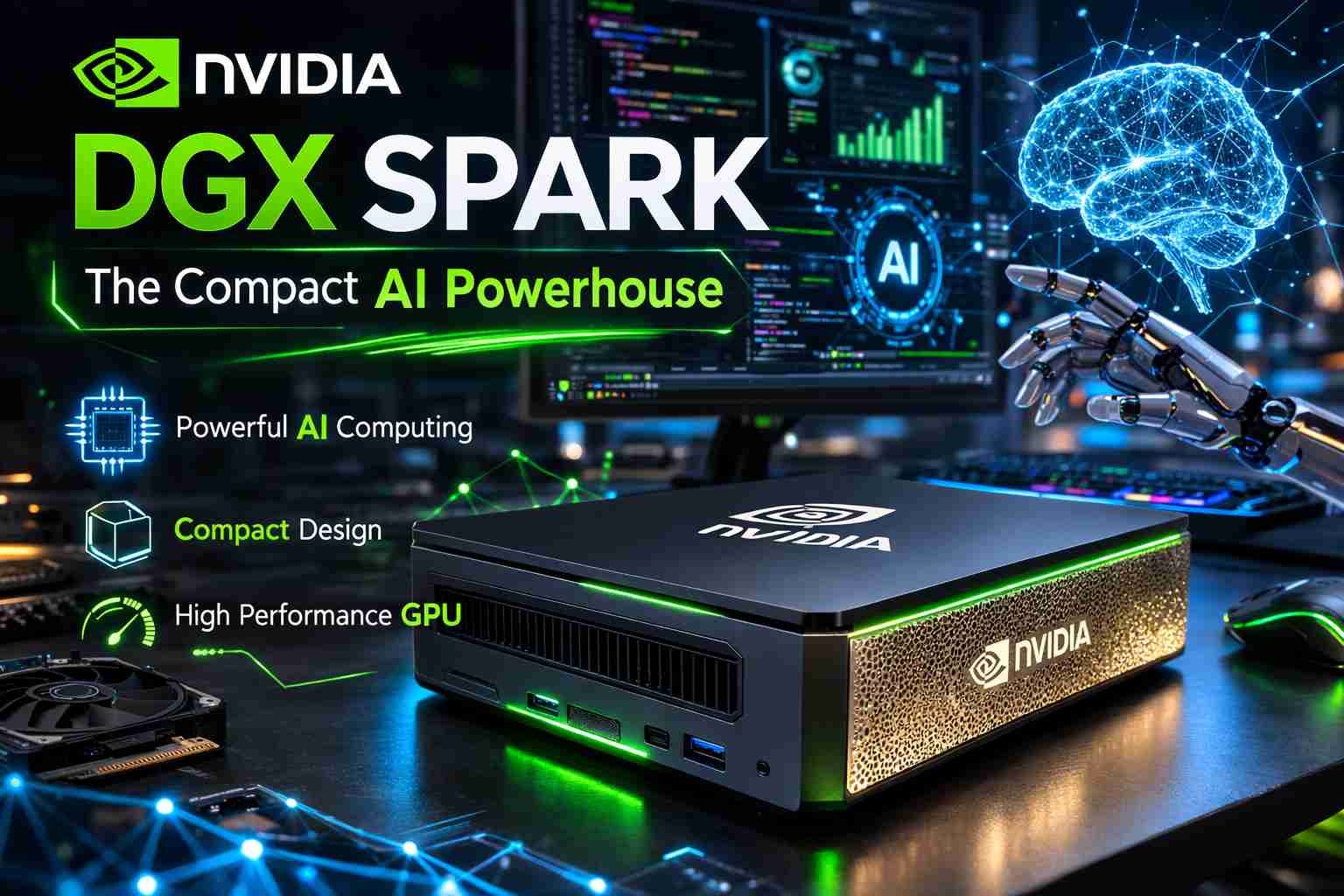
Artificial intelligence development has traditionally required expensive data centers, specialized hardware, and large engineering teams. However, the rapid evolution of AI hardware is beginning to change this reality. New compact systems are making it possible for researchers, developers, and startups to access powerful AI computing capabilities without building massive infrastructure. One such innovation is DGX Spark, a system designed to bring enterprise-level AI performance into a smaller and more accessible form.
Instead of relying on remote cloud resources or large-scale GPU clusters, modern AI developers increasingly want local compute power for experimentation, training smaller models, and testing workflows. This shift has created demand for compact yet powerful machines that can handle AI workloads efficiently. The introduction of DGX Spark represents an important step in this direction, offering a platform that combines NVIDIA’s AI expertise with a form factor that suits labs, universities, and smaller teams.
Understanding how this system works and why it matters requires looking beyond marketing headlines. It is necessary to examine its architecture, use cases, and the broader impact it could have on the AI development ecosystem.
What DGX Spark Is and Why It Matters
DGX Spark is designed as a compact AI computing platform that delivers high-performance GPU acceleration in a smaller system compared to traditional DGX servers. Historically, NVIDIA’s DGX line has been known for massive AI supercomputing systems used by major enterprises and research institutions. Those machines are powerful but expensive and often require specialized infrastructure.
This new system aims to bridge the gap between enterprise-scale AI servers and smaller development machines. By combining advanced GPU architecture, optimized AI software, and efficient cooling design, DGX Spark provides a workstation-like solution capable of running demanding AI workloads.
The significance of this system lies in accessibility. Many organizations want the performance of dedicated AI hardware but cannot justify the cost or space requirements of large server racks. A compact DGX-style machine allows developers to prototype models locally, perform inference tasks, and run smaller training jobs without relying entirely on cloud providers.
This shift toward localized AI computing is becoming increasingly important as companies prioritize data privacy, faster experimentation cycles, and predictable computing costs.
Core Architecture and Hardware Design
At the heart of DGX Spark is NVIDIA’s GPU architecture optimized for artificial intelligence workloads. Unlike general-purpose computing machines, AI systems require hardware capable of processing massive parallel operations efficiently. GPUs excel at this because they contain thousands of cores designed to handle matrix operations, which are essential for neural networks.
The system integrates high-performance GPUs with specialized AI acceleration technologies such as tensor cores. These cores are built specifically to accelerate deep learning calculations, enabling faster training and inference for modern AI models.
Another important aspect of the hardware design is memory architecture. AI workloads require extremely fast memory access to handle large datasets and model parameters. DGX Spark includes high-bandwidth memory configurations that allow the GPU to process data quickly without bottlenecks.
Cooling and power efficiency also play an important role. High-performance GPUs generate significant heat, and compact systems must manage this efficiently. The system uses optimized airflow and thermal engineering to maintain stable performance during long AI workloads.
Software Ecosystem and AI Optimization
Hardware alone is not enough to deliver high performance in artificial intelligence workloads. Software optimization plays an equally important role. NVIDIA has built a strong ecosystem of AI development tools that integrate directly with its hardware platforms.
DGX Spark benefits from this ecosystem by supporting widely used frameworks such as TensorFlow, PyTorch, and other machine learning libraries. These frameworks are optimized to run efficiently on NVIDIA GPUs, enabling developers to accelerate model training without rewriting their code.
The system also supports NVIDIA CUDA, which allows developers to access GPU acceleration directly from their applications. CUDA has become a standard platform for GPU computing and is widely used in research labs and production AI systems.
In addition, the machine can run NVIDIA’s AI software stacks that include preconfigured libraries, containers, and development environments. This significantly reduces the time required to set up an AI workstation and allows teams to focus on building models rather than configuring infrastructure.
Real-World Use Cases for AI Developers
The most important question for any AI hardware platform is how it performs in real-world scenarios. DGX Spark is designed to support several practical use cases that developers encounter daily.
One of the most common applications is model experimentation and prototyping. AI researchers often need to test different architectures and training strategies before scaling to large clusters. Having a powerful local system allows them to run experiments quickly and iterate faster.
Another major use case is inference deployment and testing. Many AI applications require running trained models to process data in real time. With local GPU acceleration, developers can simulate production environments and optimize performance before deploying models to larger systems.
Educational institutions may also benefit from this type of hardware. Universities teaching machine learning courses can use compact AI systems to give students hands-on experience with real GPU infrastructure instead of relying solely on cloud resources.
Startups working with computer vision, natural language processing, or generative AI can use DGX Spark as a development hub for training smaller models and running development pipelines.
Benefits Compared to Traditional AI Servers
Traditional AI servers often require dedicated server rooms, advanced cooling systems, and large capital investments. These requirements can be barriers for smaller organizations that want to build AI capabilities internally.
DGX Spark addresses several of these challenges by offering a more compact and manageable solution. Because the system is smaller, it can be installed in a standard office environment without specialized infrastructure.
Another advantage is faster development cycles. Developers working with cloud GPUs sometimes experience delays due to resource availability or data transfer limitations. Local AI hardware eliminates many of these bottlenecks and allows teams to experiment continuously.
Cost predictability is another benefit. Cloud-based AI workloads can become expensive when training models for long periods. Owning a dedicated system provides more predictable operating costs over time.
Finally, local hardware provides greater control over sensitive data. Organizations working with proprietary datasets or confidential information may prefer running models locally rather than transferring data to external cloud platforms.
Impact on the Future of AI Workstations
The introduction of systems like DGX Spark signals a broader shift in how AI infrastructure may evolve in the coming years. While large-scale data centers will always be necessary for training massive foundation models, many AI tasks can be performed effectively on smaller machines.
This trend could lead to the rise of AI workstations that sit between personal computers and full-scale supercomputers. These machines would allow developers to perform meaningful AI research without requiring access to expensive clusters.
As AI becomes more integrated into everyday software development, more engineers will need access to GPU-accelerated computing. Compact AI platforms may become a standard tool for data scientists, similar to how powerful workstations are used in video editing and 3D rendering.
Such systems also encourage experimentation. When developers have direct access to hardware, they can test new ideas more freely without worrying about cloud billing or infrastructure limitations.
Challenges and Considerations
Despite its advantages, no AI system is perfect. There are still limitations that developers should consider when evaluating compact AI hardware.
One limitation is scalability. Large foundation models with billions of parameters still require distributed training across multiple GPUs or clusters. A compact machine may not be able to handle extremely large workloads.
Another consideration is hardware cost. While smaller than enterprise AI servers, systems like DGX Spark may still represent a significant investment for individuals or very small teams.
Software compatibility is also an important factor. Developers must ensure that their workflows, frameworks, and datasets can run efficiently on the system without requiring additional infrastructure.
Finally, organizations must evaluate whether their workloads truly benefit from local AI hardware or whether cloud-based solutions remain more flexible for their specific needs.
The Growing Demand for Compact AI Systems
The demand for powerful yet compact AI computing platforms continues to grow as artificial intelligence becomes more widespread. Businesses across industries—from healthcare and finance to robotics and media—are integrating machine learning into their operations.
As a result, many organizations are searching for hardware solutions that balance performance, cost, and accessibility. Systems such as DGX Spark represent an attempt to meet this demand by providing dedicated AI performance in a manageable form factor.
If this trend continues, we may see an entire category of AI development machines emerge, offering different levels of performance for different types of workloads.
This evolution could make AI research more accessible to smaller teams and independent developers, ultimately accelerating innovation across the technology industry.
More Details : The Science And Systems Behind CONTEXTO.ME
Frequently Asked Questions (FAQs)
1. What is DGX Spark used for?
DGX Spark is designed for AI development tasks such as model training, experimentation, and inference testing using GPU acceleration.
2. Who should consider using DGX Spark?
AI researchers, startups, universities, and developers who need local GPU computing for machine learning workloads can benefit from using it.
3. Can DGX Spark replace large AI clusters?
No. It is mainly intended for development and smaller workloads. Large-scale model training still requires multi-GPU clusters or data center infrastructure.
4. Which AI frameworks work with DGX Spark?
Popular frameworks like TensorFlow, PyTorch, and other CUDA-supported libraries can run on the system.
5. Is DGX Spark better than cloud GPUs?
It depends on the workload. Local hardware offers predictable costs and faster experimentation, while cloud GPUs provide scalability for very large training jobs.

The Life of Chuck: A Deep Dive into an Enigmatic Film

Encanto Characters Explained: The Madrigal Family, Their Gifts, and What They Mean

I Tested Originality.AI’s AI Detector: A Comprehensive Review

The Ultimate Guide to Literary Devices: Exploring the Tools of Writing

What Does “Tralalero Tralala” Mean? Unpacking the Mystery

Apothecary Diaries Season 3: Everything You Need to Know About the Upcoming Installment

10 Things You Should Know About Yuta Okkotsu Before Jujutsu Kaisen Season 3

Jurassic World Rebirth Dinosaurs: A Deep Dive into the New Dinosaurs and Their Threat Levels

The Red String Theory: Exploring Fate and Connection

ReMarkable 2 Writing Tablet: A Comprehensive Review of Its Features, Performance, and Benefits

Semana Santa 2026: Dates, Traditions, and Global Celebrations

Understanding pi123: Meaning, Uses, and Why It Matters

Pedantic: Meaning, Importance, and Why Being Pedantic Can Actually Be a Strength

What Is a Runtime Environment? A Complete Beginner-Friendly Guide

A Practical Look at the Most Impactful Marketing Campaigns of 2025

10 Best Coding Podcasts Every Developer Should Listen to in 2026

Claude Cowork: A Complete Guide to Anthropic’s AI Desktop Agent

Debate Unlocked: Are There More Doors or Wheels in the World?

Beyond the Hype: A Practical Look at SOUL AI

Playing Games On Blog Playbattlesquare Gaming Hub: Smart Ways to Learn, Play, and Improve Online
The Life of Chuck: A Deep Dive into an Enigmatic Film
Encanto Characters Explained: The Madrigal Family, Their Gifts, and What They Mean
I Tested Originality.AI’s AI Detector: A Comprehensive Review
The Ultimate Guide to Literary Devices: Exploring the Tools of Writing
What Does “Tralalero Tralala” Mean? Unpacking the Mystery
Apothecary Diaries Season 3: Everything You Need to Know About the Upcoming Installment
10 Things You Should Know About Yuta Okkotsu Before Jujutsu Kaisen Season 3
Jurassic World Rebirth Dinosaurs: A Deep Dive into the New Dinosaurs and Their Threat Levels
The Red String Theory: Exploring Fate and Connection
ReMarkable 2 Writing Tablet: A Comprehensive Review of Its Features, Performance, and Benefits
-

 Tech1 month ago
xxx is equal to 2022: A Complete Informative Explanation of a Cubic Equation
-

 Entertainment2 months ago
The Artistic World of Gege Akutami: A Mastermind Behind Jujutsu Kaisen
-

 Entertainment2 months ago
Jujutsu Kaisen Modulo: A Deep Informative Exploration of Power Systems, Symbolism, and Modern Anime Culture
-

 Entertainment2 months ago
Muichiro Personality Explained: Traits, Mindset, and Emotional Depth