
Tech
Walter Russell Periodic Table: A Different Vision of the Elements and the Universe

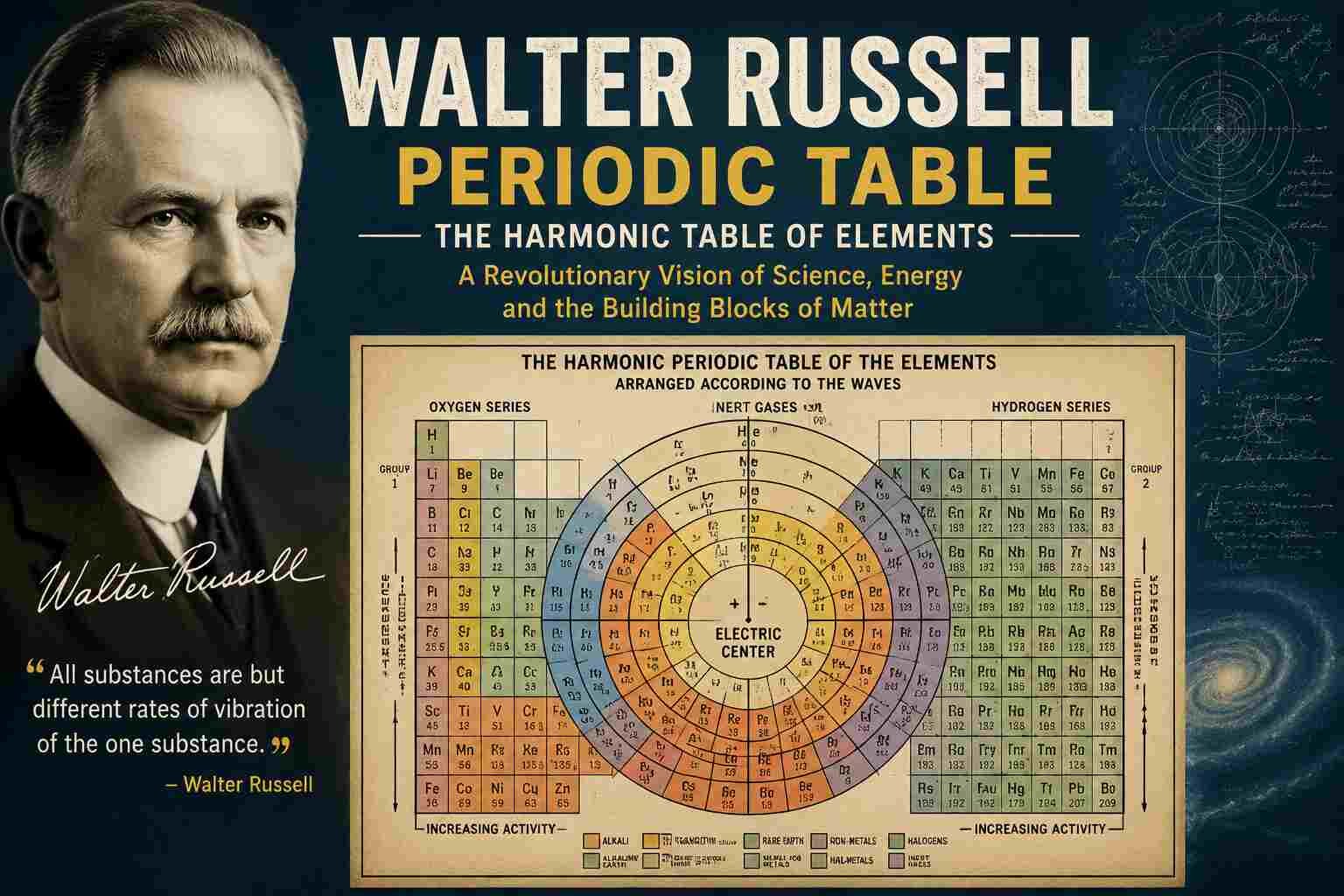
The periodic table most students learn in school is based on atomic numbers, electron configurations, and modern quantum chemistry. However, throughout history, several thinkers proposed alternative ways to understand the structure of matter. One of the most unusual and widely discussed examples is the walter russell periodic table.
Walter Russell was not a traditional scientist. He was an artist, philosopher, architect, and author who believed the universe operated through rhythmic balanced waves rather than purely mechanical forces. His version of the periodic table reflected this worldview. Instead of focusing only on atomic structure, Russell tried to connect chemistry, energy, motion, light, and universal balance into one grand system.
Even decades after his work was published, the Walter Russell approach continues to attract interest from researchers of alternative science, metaphysics, and historical theories of matter. While mainstream science does not accept his table as a replacement for the standard periodic table, it remains an important example of how some thinkers attempted to explain nature through harmony and cyclic patterns.
Who Was Walter Russell?
Walter Russell was born in 1871 in the United States. He became known for his work as a painter and sculptor before later developing philosophical and scientific ideas. Russell claimed to have experienced a profound spiritual awakening in which he gained insights into the structure of the universe.
After this experience, he began writing about cosmology, matter, electricity, light, and human consciousness. His theories were eventually presented in books such as The Universal One and The Secret of Light. Within these writings, he introduced what later became known as the walter russell periodic table.
Russell believed that traditional science only explained part of reality. According to him, the universe operated through balanced wave motions that created all matter. In his view, elements were not isolated substances but stages in rhythmic cycles of energy.
The Core Idea Behind Russell’s System
The main concept behind Russell’s table is that matter is formed through wave motion. He rejected the idea that atoms are solid particles moving randomly in empty space. Instead, he described the universe as a continuous field of motion created through compression and expansion.
Russell believed every element is part of a repeating cycle. These cycles move from generation to radiation, from growth to decay, and from compression to expansion. In his system, matter constantly changes through rhythmic balance.
This approach made his periodic table very different from the standard scientific version. Instead of arranging elements only by proton number, he organized them according to wave octaves and balanced pairs.
He often compared the structure of matter to music. Just as musical notes repeat in octaves, Russell believed elements repeated in energetic patterns throughout the universe
Structure of the Walter Russell Periodic Table
The walter russell periodic table is usually displayed in a circular or wave-based design rather than the rectangular format used in conventional chemistry.
Russell arranged elements in octaves, similar to musical scales. Each octave represented a stage in the evolution of matter. He believed the elements were generated through spiraling motion and that each group reflected a balance between inward and outward forces.
One of the most distinctive features of his table is symmetry. Russell emphasized balance throughout nature. In his model, every action has an equal opposite reaction, and every element exists within a dynamic relationship.
He also proposed the existence of “inert gases” as balancing points within each octave. These gases represented moments of equilibrium before matter transformed into the next stage.
Unlike modern chemistry, Russell’s table was deeply connected to philosophical ideas about polarity, duality, and cosmic rhythm.
How Russell Viewed Elements
Russell did not see elements as permanent substances. He believed elements were temporary conditions created by motion.
According to his theory, elements emerge from compressed energy and later dissolve back into space through radiation. Matter, in his view, is not static but constantly cycling between visible and invisible states.
For example, Russell interpreted carbon not merely as an atom with six protons but as a stage in a larger energetic process. Gold, uranium, hydrogen, and oxygen were also considered expressions of wave conditions rather than fixed building blocks.
This interpretation differs strongly from standard atomic theory, where elements are defined by measurable atomic properties.
Russell’s approach focused more on energetic relationships and less on laboratory measurements. That is one reason mainstream science never adopted his system.
Comparison With the Modern Periodic Table
The standard periodic table used today is based on atomic number and electron configuration. It is supported by extensive experiments, quantum mechanics, and decades of chemical research.
The walter russell periodic table, on the other hand, was developed from philosophical reasoning and Russell’s interpretation of natural laws.
Here are some major differences:
Standard Periodic Table
- Organized by atomic number
- Supported by measurable experiments
- Based on quantum theory
- Used in chemistry and physics worldwide
- Predicts chemical behavior accurately
Walter Russell’s Table
- Organized through wave octaves
- Focuses on balance and rhythmic motion
- Connects science with philosophy
- Uses circular and symmetrical structures
- Emphasizes universal energy patterns
While the scientific community accepts the modern table because it produces testable results, Russell’s model remains more speculative and symbolic.
Russell’s Concept of Wave Octaves
Wave octaves are central to Russell’s cosmology. He believed all creation follows rhythmic cycles similar to musical harmonies.
In this system, each octave contains stages of development. Matter grows through compression until reaching a peak condition, then gradually radiates outward again.
Russell used this concept to explain:
- Formation of elements
- Planetary motion
- Light and electricity
- Human consciousness
- Universal balance
He believed the same laws governing music also governed chemistry and astronomy.
This philosophical connection between sound, energy, and matter gave the Walter Russell model its unique identity.
Why Some People Still Study Russell’s Ideas
Although mainstream scientists generally reject Russell’s theories, his ideas continue to interest certain groups.
Some people are drawn to the spiritual side of his teachings. Others appreciate the artistic and symbolic nature of his cosmic model. Independent researchers often study his work alongside alternative energy theories and metaphysical science.
Several reasons explain the lasting interest:
- His ideas combine science and philosophy
- The table has visually unique symmetry
- Russell emphasized universal harmony
- His work explores consciousness alongside physics
- Alternative science communities continue discussing his theories
For many readers, the appeal lies less in laboratory accuracy and more in the broader vision Russell presented about the universe.
Scientific Criticism of Russell’s Theory
Modern scientists criticize Russell’s system because it lacks experimental evidence and mathematical validation.
Chemistry and physics rely heavily on repeatable experiments. Scientific theories must make accurate predictions that can be tested independently. Russell’s writings often used symbolic language instead of precise scientific formulas.
Critics argue that:
- His concepts are difficult to test experimentally
- Many claims contradict modern atomic physics
- The theory lacks peer-reviewed scientific support
- Some terminology is vague or philosophical
Because of these issues, universities and scientific institutions do not use Russell’s table in chemistry education.
Still, even critics acknowledge that Russell’s work remains historically interesting as an example of alternative cosmological thinking.
The Spiritual Side of Russell’s Work
One reason the walter russell periodic table stands apart from scientific charts is its spiritual dimension.
Russell believed matter and consciousness were deeply connected. He viewed the universe as an intelligent system operating through balance and rhythmic interchange.
In his philosophy:
- Light was the foundation of creation
- Motion produced matter
- Opposites worked together harmoniously
- Humans reflected universal laws internally
This spiritual perspective influenced every part of his scientific ideas. His table was not only meant to classify elements but also to explain humanity’s relationship with nature.
Because of this, many readers approach his work more as philosophical cosmology than practical chemistry.
Influence on Alternative Science Communities
Russell’s writings influenced several alternative science movements during the twentieth century.
Researchers interested in free energy, sacred geometry, vibrational physics, and metaphysical cosmology sometimes reference his ideas. His emphasis on wave motion and universal balance inspired thinkers searching for nontraditional explanations of matter and energy.
Some communities also connect his theories with:
- Cymatics
- Harmonic resonance
- Energy healing concepts
- Sacred geometry
- Esoteric philosophy
However, these connections remain outside mainstream scientific research.
Understanding the Legacy of Walter Russell
Walter Russell’s legacy is complex. To scientists, his periodic table represents a speculative theory unsupported by modern evidence. To followers and independent thinkers, it represents a bold attempt to unify science, philosophy, art, and spirituality.
His work reminds readers that the history of science includes many unconventional ideas. Some theories disappear entirely, while others continue inspiring curiosity and debate.
Whether accepted scientifically or not, Russell’s writings continue to encourage people to think about the universe in broader and more imaginative ways.
Conclusion
The walter russell periodic table remains one of the most unusual alternative interpretations of matter ever proposed. Unlike the modern periodic table built through experimental chemistry, Russell’s system was based on wave motion, balance, rhythm, and universal harmony.
His approach blended science, philosophy, and spirituality into a single worldview. Although mainstream researchers do not accept his table as scientifically valid, it still attracts readers interested in cosmology, metaphysics, and historical theories of nature.
Walter Russell attempted to describe the universe as a living rhythmic system where matter, energy, and consciousness are interconnected. That vision continues to fascinate people who explore ideas beyond conventional scientific frameworks.
More details : Modern Data Architecture Guide: Practical Database Design Patterns for Developers
FAQs
1. What is the Walter Russell periodic table?
It is an alternative periodic table created by Walter Russell based on wave motion, balance, and energetic octaves instead of atomic numbers.
2. Is the Walter Russell periodic table scientifically accepted?
No. Modern chemistry and physics do not recognize it as a valid replacement for the standard periodic table because it lacks experimental evidence.
3. How is Russell’s table different from the modern periodic table?
Russell organized elements through rhythmic wave patterns and symmetry, while the modern table is based on atomic structure and electron configuration.
4. Why do people still study Walter Russell’s ideas?
Many people are interested in his philosophical and spiritual interpretation of the universe, especially concepts involving harmony and energy.
5. Did Walter Russell write books about his theories?
Yes. His most famous books include The Universal One and The Secret of Light, where he explained his cosmological and scientific ideas.

12 Best Omegle Alternatives for Random Video Chat and Meeting New People

Dbxbqm Meaning: Why It Appears When You Try to Type YouTube

Immediate Loading Implants: How “Fixed Teeth in 48 Hours” Really Works

How UK Mobile Proxies Help Businesses Test Their Websites

Gen AI in Supply Chain: Using Supply Chain Benchmarks to Improve Performance

What Is the UK Theory Test? How It Works, Cost and Pass Mark

Weather the Storm: Why Totally Branded Umbrellas are the UK’s Most Appreciated Gift

How to Store, Wind, and Travel With Your Automatic Watch Collection Without Damaging It

What Do HubSpot Onboarding Services Include?

AI in Supply Chain: How AI Consulting Services Help Build More Intelligent and Resilient Operations
Immediate Loading Implants: How “Fixed Teeth in 48 Hours” Really Works
How UK Mobile Proxies Help Businesses Test Their Websites
Gen AI in Supply Chain: Using Supply Chain Benchmarks to Improve Performance
12 Best Omegle Alternatives for Random Video Chat and Meeting New People
Dbxbqm Meaning: Why It Appears When You Try to Type YouTube
12 Best Omegle Alternatives for Random Video Chat and Meeting New People
Dbxbqm Meaning: Why It Appears When You Try to Type YouTube
Immediate Loading Implants: How “Fixed Teeth in 48 Hours” Really Works
How UK Mobile Proxies Help Businesses Test Their Websites
Gen AI in Supply Chain: Using Supply Chain Benchmarks to Improve Performance
What Is the UK Theory Test? How It Works, Cost and Pass Mark
Weather the Storm: Why Totally Branded Umbrellas are the UK’s Most Appreciated Gift
How to Store, Wind, and Travel With Your Automatic Watch Collection Without Damaging It
What Do HubSpot Onboarding Services Include?
AI in Supply Chain: How AI Consulting Services Help Build More Intelligent and Resilient Operations
-

 Tech9 months ago
xxx is equal to 2022: A Complete Informative Explanation of a Cubic Equation
-

 Celebrity8 months ago
Izzie Balmer Partner: A Deep Dive into the Relationship with Will Hawley
-

 Entertainment9 months ago
The Artistic World of Gege Akutami: A Mastermind Behind Jujutsu Kaisen
-

 Food5 months ago
Best Sushi Rice Brands: A Complete Guide to Choosing the Right Rice for Sushi