
Tech
Mastering Declarative Sentences: The Foundation of Clear English Communication

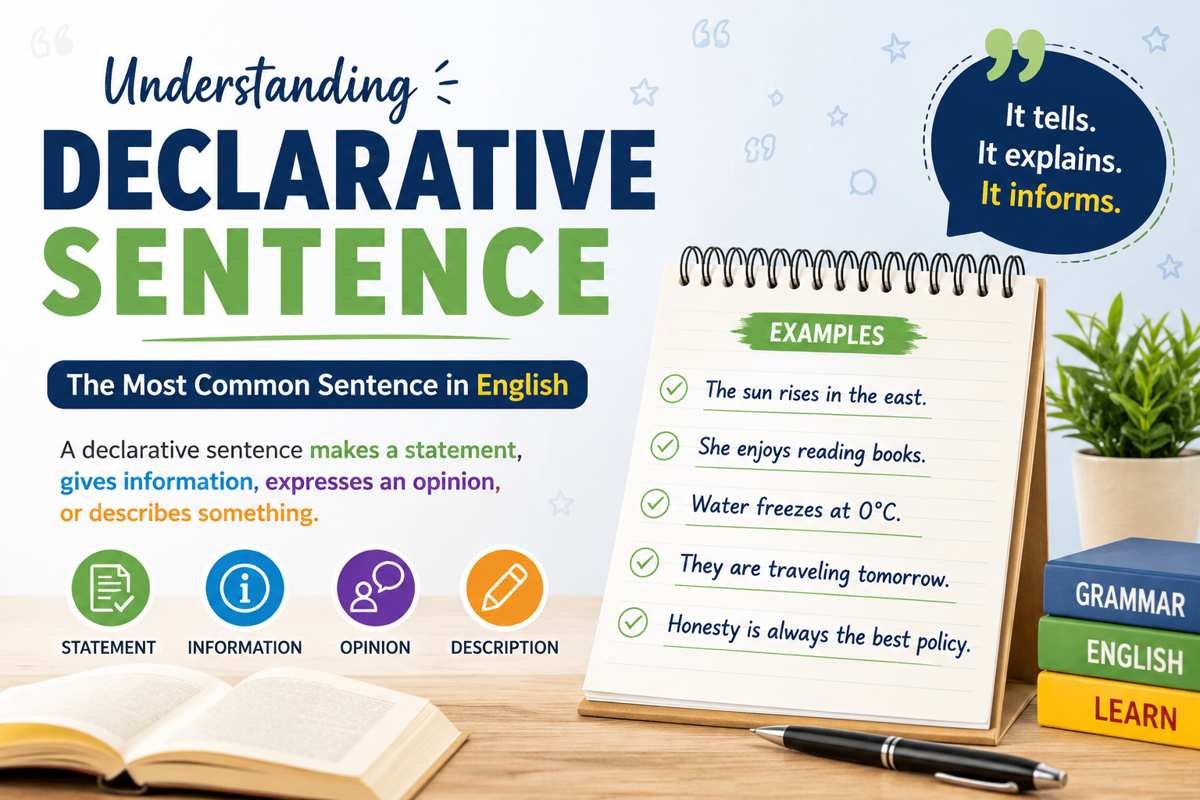
Every language relies on sentence structures that help people express ideas, share information, and communicate effectively. In English, one of the most common and useful sentence types is the Declarative Sentence. Whether you are writing an academic essay, a business email, a blog post, or a simple text message, this sentence form plays a central role in delivering information clearly and directly.
Because it is used so frequently, understanding how it works can significantly improve both writing and speaking skills. A strong grasp of this sentence type helps learners communicate confidently, organize thoughts logically, and avoid unnecessary confusion.
What Is a Declarative Sentence?
A Declarative Sentence is a sentence that makes a statement, provides information, expresses an opinion, or presents a fact. Its primary purpose is to tell the reader or listener something rather than ask a question, give a command, or express strong emotion.
These sentences usually end with a period and follow a straightforward structure that makes them easy to understand. They are the most widely used sentence form in everyday English because communication often involves sharing information.
Examples include:
- The library opens at nine o’clock.
- She enjoys reading historical novels.
- The weather is pleasant today.
- Technology has changed the way people work.
Each example simply presents information without asking for a response or giving instructions.
Why This Sentence Type Is Important
Clear communication depends on clarity, and this sentence structure is designed specifically for that purpose. Most conversations, articles, reports, and educational materials rely heavily on statements that provide facts or explain ideas.
When people communicate, they often need to:
- Share information
- Describe events
- Explain concepts
- Present opinions
- Report findings
All of these functions are commonly performed through a Declarative Sentence. Without it, written and spoken communication would become difficult to organize and understand.
Main Characteristics
It Makes a Statement
The defining feature of this sentence type is that it presents information. The statement may be factual, opinion-based, or descriptive.
Examples:
- Water freezes at zero degrees Celsius.
- Traveling broadens a person’s perspective.
- The meeting begins at noon.
In each case, the speaker is communicating information rather than seeking an answer.
It Usually Ends With a Period
Most statements conclude with a period. This punctuation signals that the sentence is complete and that information has been delivered.
Examples:
- The train arrived on time.
- Our team completed the project successfully.
The period helps readers recognize that the thought has ended.
It Follows a Logical Structure
English statements generally follow a subject-verb pattern.
Examples:
- Sarah sings beautifully.
- The dog barked loudly.
- Students completed their assignments.
This predictable structure contributes to readability and comprehension.
Different Forms of Declarative Statements
Positive Statements
Positive statements present information without negation.
Examples:
- The museum is open today.
- They live near the city center.
- He enjoys learning new languages.
These sentences communicate information directly and positively.
Negative Statements
Negative statements include words such as “not,” “never,” or “no” to indicate the opposite of something.
Examples:
- The store is not open today.
- She never misses her morning walk.
- We do not have enough time.
Even though the meaning is negative, the sentence still functions as a statement.
Examples in Everyday Communication
In Conversations
People naturally use statements throughout daily interactions.
Examples:
- I finished my homework.
- The restaurant serves excellent food.
- My brother moved to another city.
These sentences help individuals share information quickly and efficiently.
In Academic Writing
Educational and research-based writing depends heavily on statements.
Examples:
- Climate change affects ecosystems worldwide.
- Reading regularly improves vocabulary development.
- Exercise contributes to overall health.
Such statements allow writers to explain concepts and present evidence clearly.
In Professional Communication
Business environments require concise and direct communication.
Examples:
- The report will be submitted tomorrow.
- Sales increased during the last quarter.
- The conference begins at 10 a.m.
Professional writing often prioritizes clarity, making statement-based sentences especially valuable.
Comparing Sentence Types
Statements vs. Questions
A statement provides information, while a question seeks information.
Statement:
- The meeting starts at three o’clock.
Question:
- What time does the meeting start?
Although both relate to the same topic, their purposes differ significantly.
Statements vs. Commands
Commands instruct someone to do something.
Statement:
- You should submit the application today.
Command:
- Submit the application today.
The first provides information or advice, while the second gives a direct instruction.
Statements vs. Exclamations
Exclamatory sentences express strong emotions.
Statement:
- The view from the mountain is beautiful.
Exclamation:
- What a beautiful view from the mountain!
The emotional intensity distinguishes the exclamation from the statement.
Common Uses in Writing
Presenting Facts
Writers often use statements to communicate factual information.
Examples:
- Earth revolves around the sun.
- Plants require sunlight to grow.
- The Pacific Ocean is the largest ocean on Earth.
Facts become easier to understand when presented clearly and directly.
Sharing Opinions
Opinions can also be expressed through statements.
Examples:
- Public transportation should be expanded.
- Reading fiction develops imagination.
- Online learning offers valuable flexibility.
Although opinions may be subjective, they are still presented as statements.
Describing Events
Narrative and descriptive writing frequently relies on this sentence structure.
Examples:
- The festival attracted thousands of visitors.
- Heavy rain delayed the flight.
- The team celebrated its victory.
These sentences help readers understand what happened.
How Students Can Improve Their Usage
Focus on Clarity
A strong statement should communicate a single idea clearly. Avoid unnecessary words that may confuse readers.
Less Clear:
- Due to various circumstances and factors, the event experienced a delay.
Clearer:
- The event was delayed because of several factors.
Simple wording often produces stronger communication.
Use Correct Grammar
Proper grammar strengthens readability and professionalism.
Example:
- The students completed the project successfully.
Maintaining correct subject-verb agreement and sentence structure helps readers understand the message immediately.
Vary Sentence Length
Although statements are common, writers should vary their length to create a more engaging reading experience.
Short:
- The results were positive.
Longer:
- The results were positive because the new strategy improved efficiency across multiple departments.
Combining different lengths creates a natural flow.
Common Mistakes to Avoid
Writing Incomplete Statements
A complete sentence needs a subject and a verb.
Incorrect:
- After the meeting.
Correct:
- We discussed the proposal after the meeting.
Fragments can make writing appear unfinished.
Creating Run-On Sentences
Run-on sentences combine multiple ideas without proper punctuation.
Incorrect:
- The project ended yesterday everyone celebrated the achievement.
Correct:
- The project ended yesterday, and everyone celebrated the achievement.
Proper punctuation improves readability.
Overcomplicating Simple Ideas
Many writers believe long sentences sound more impressive. In reality, clarity is often more effective.
Complex:
- The implementation of innovative methodologies facilitated improvements.
Simple:
- The new methods improved results.
Direct language usually communicates ideas more successfully.
Role in Effective Communication
The ability to express thoughts clearly is one of the most valuable communication skills. Statements provide structure, reduce ambiguity, and help audiences understand information quickly.
Whether someone is writing a report, giving a presentation, publishing an article, or participating in a conversation, clear statements create a strong foundation for communication. They allow ideas to be presented logically and ensure that important information reaches the intended audience.
Because of their simplicity and versatility, statements remain one of the most powerful tools in the English language.
Conclusion
A Declarative Sentence is the cornerstone of effective English communication. It allows speakers and writers to present facts, opinions, descriptions, and explanations in a clear and organized manner. From everyday conversations to academic papers and professional documents, this sentence type appears in nearly every form of communication.
Understanding its structure, purpose, and proper usage can improve writing quality, strengthen communication skills, and enhance overall language proficiency. By focusing on clarity, grammar, and logical organization, anyone can use statements more effectively and communicate ideas with confidence.
More Details : How to Declutter Digital Files: A Comprehensive Guide
(FAQs)
1. What is a Declarative Sentence?
It is a sentence that makes a statement, shares information, or expresses an opinion.
2. How does it usually end?
It typically ends with a period.
3. Can it express an opinion?
Yes, statements can present both facts and opinions.
4. Is it the most common sentence type in English?
Yes, it is widely used in everyday speech and writing.
5. What is a simple example?
“The sun rises in the east.” is a simple example of a declarative statement.

Immediate Loading Implants: How “Fixed Teeth in 48 Hours” Really Works

How UK Mobile Proxies Help Businesses Test Their Websites

Gen AI in Supply Chain: Using Supply Chain Benchmarks to Improve Performance

What Is the UK Theory Test? How It Works, Cost and Pass Mark

Weather the Storm: Why Totally Branded Umbrellas are the UK’s Most Appreciated Gift

How to Store, Wind, and Travel With Your Automatic Watch Collection Without Damaging It

What Do HubSpot Onboarding Services Include?

AI in Supply Chain: How AI Consulting Services Help Build More Intelligent and Resilient Operations

Hungary Dental Tourism: Quality Dental Care at Affordable Prices

Timur Turlov: A Vision for the Future of Global Chess
How to Store, Wind, and Travel With Your Automatic Watch Collection Without Damaging It
What Is the UK Theory Test? How It Works, Cost and Pass Mark
Weather the Storm: Why Totally Branded Umbrellas are the UK’s Most Appreciated Gift
Gen AI in Supply Chain: Using Supply Chain Benchmarks to Improve Performance
How UK Mobile Proxies Help Businesses Test Their Websites
Immediate Loading Implants: How “Fixed Teeth in 48 Hours” Really Works
Immediate Loading Implants: How “Fixed Teeth in 48 Hours” Really Works
How UK Mobile Proxies Help Businesses Test Their Websites
Gen AI in Supply Chain: Using Supply Chain Benchmarks to Improve Performance
What Is the UK Theory Test? How It Works, Cost and Pass Mark
Weather the Storm: Why Totally Branded Umbrellas are the UK’s Most Appreciated Gift
How to Store, Wind, and Travel With Your Automatic Watch Collection Without Damaging It
What Do HubSpot Onboarding Services Include?
AI in Supply Chain: How AI Consulting Services Help Build More Intelligent and Resilient Operations
Hungary Dental Tourism: Quality Dental Care at Affordable Prices
Timur Turlov: A Vision for the Future of Global Chess
-

 Tech8 months ago
xxx is equal to 2022: A Complete Informative Explanation of a Cubic Equation
-

 Celebrity8 months ago
Izzie Balmer Partner: A Deep Dive into the Relationship with Will Hawley
-

 Entertainment8 months ago
The Artistic World of Gege Akutami: A Mastermind Behind Jujutsu Kaisen
-

 Food5 months ago
Best Sushi Rice Brands: A Complete Guide to Choosing the Right Rice for Sushi