
How to
How to Read Sheet Music Basics: A Complete Beginner’s Guide

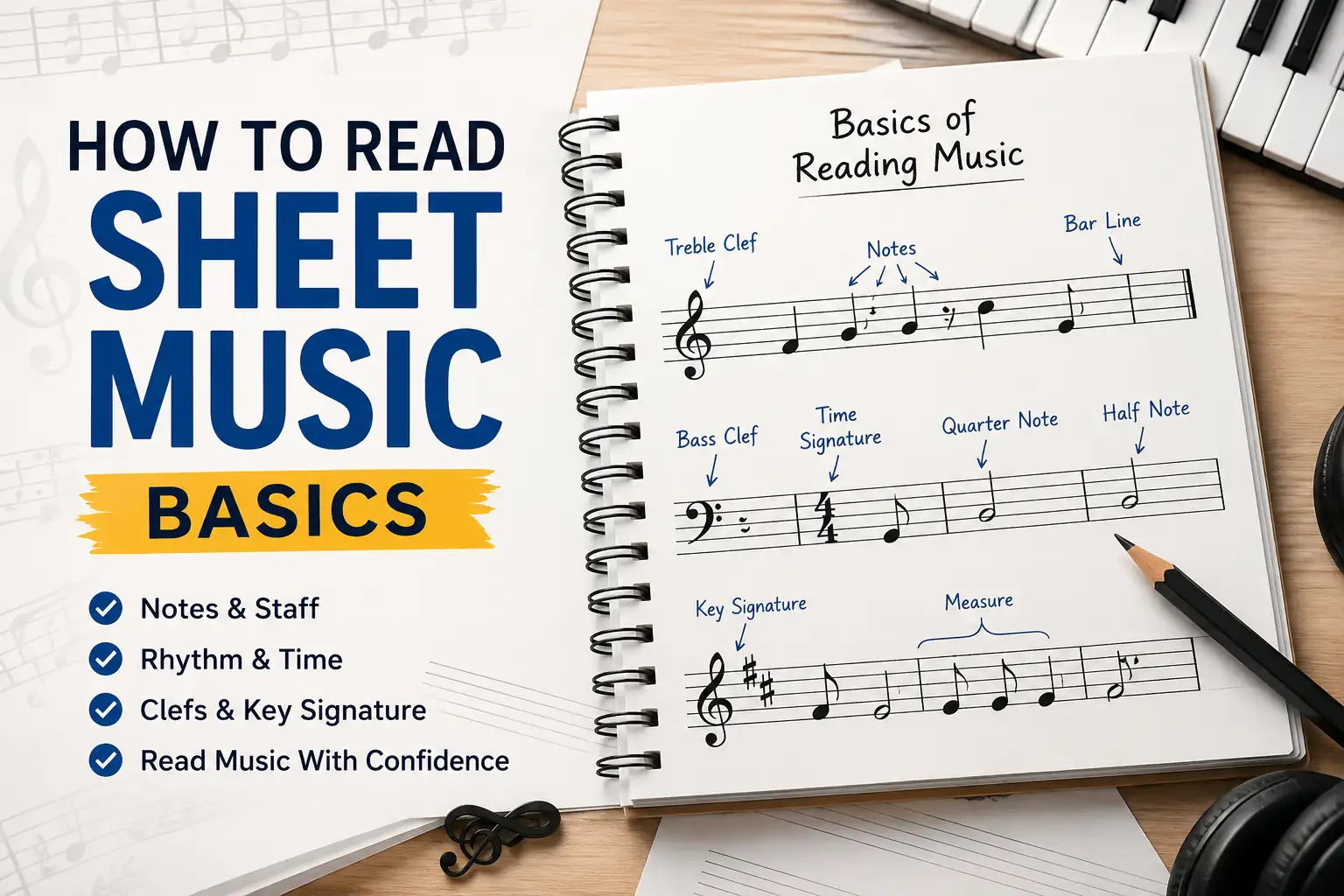
Learning how to read sheet music basics may seem difficult at first, but it becomes much easier once you understand the symbols and patterns used in written music. Whether you want to play the piano, guitar, violin, flute, or sing confidently, reading sheet music opens the door to thousands of songs and helps you become a stronger musician.
Unlike learning songs by ear alone, sheet music allows you to understand rhythm, pitch, timing, and musical expression exactly as the composer intended. The good news is that you don’t need years of experience to get started. By learning one concept at a time, you’ll quickly recognize notes, rhythms, and musical markings with confidence.
What Is Sheet Music?
Sheet music is a written form of musical notation that tells musicians exactly what to play or sing. Every symbol on the page has a purpose, from showing which note to play to indicating how long it should last and how loudly it should be performed.
Instead of relying on memory, musicians use sheet music as a guide. It provides a universal language that can be understood by performers around the world, regardless of their spoken language or musical style.
Why Learning Sheet Music Is Important
Understanding how to read sheet music basics helps musicians improve accuracy, technique, and confidence. Rather than memorizing every song by listening repeatedly, you can read new pieces directly from the page.
Reading music also develops your understanding of rhythm, harmony, and melody. As your skills improve, you’ll find it easier to learn challenging compositions, join bands or orchestras, accompany singers, and even write your own music.
Understanding the Musical Staff
The musical staff is the foundation of written music. It consists of five horizontal lines and four spaces. Notes are placed on these lines and spaces, with each position representing a different pitch.
The higher a note appears on the staff, the higher it sounds. Likewise, notes positioned lower on the staff produce lower pitches. Learning to identify these positions is one of the first steps toward becoming comfortable with music notation.
Musicians often use memory aids to remember the note names on the staff. These shortcuts make recognizing notes much faster during practice.
Treble Clef and Bass Clef
Most beginners first encounter two common clefs: the treble clef and the bass clef.
The treble clef is used for higher-pitched instruments and voices, including the right hand on the piano, violin, flute, and many vocal melodies. The lines represent E, G, B, D, and F, while the spaces spell the word FACE.
The bass clef represents lower-pitched sounds and is commonly used for the left hand on the piano, bass guitar, cello, trombone, and bass voices. Its lines represent G, B, D, F, and A, while the spaces are A, C, E, and G.
Learning both clefs allows musicians to play a much wider variety of music.
Learning Note Values
Reading notes isn’t only about knowing their pitch. You also need to understand how long each note should be played.
A whole note lasts four beats in common time. A half note lasts two beats, while a quarter note lasts one beat. Eighth notes receive half a beat each and are often connected with beams. Sixteenth notes divide the beat even further, allowing for quicker musical passages.
Equally important are rests, which represent periods of silence. Just like notes, rests have different lengths, helping create rhythm and balance throughout a musical piece.
Time Signatures Explained
One of the first things you’ll notice at the beginning of sheet music is the time signature. It appears immediately after the clef and key signature.
The top number tells you how many beats appear in each measure, while the bottom number indicates which note value receives one beat.
For example, 4/4 time means each measure contains four quarter-note beats. This is the most common time signature in popular music. Another popular signature is 3/4, often heard in waltzes, where each measure contains three quarter-note beats.
Understanding time signatures helps you maintain consistent rhythm while performing.
What Are Measures and Bar Lines?
Bar lines divide music into smaller sections called measures. These sections organize rhythm, making the music easier to read and count.
Each measure contains the exact number of beats specified by the time signature. As musicians become more experienced, they begin recognizing rhythmic patterns within measures rather than reading individual notes one at a time.
This improves reading speed and overall musical fluency.
Key Signatures and Musical Keys
Key signatures appear immediately after the clef and before the time signature. They consist of sharps or flats placed on specific lines and spaces.
The key signature tells you which notes remain sharp or flat throughout the piece unless canceled by another symbol called a natural sign.
Learning common key signatures gradually helps musicians recognize scales, chords, and harmonic patterns more easily. Beginners don’t need to memorize every key immediately, but understanding the concept is an important milestone.
Sharps, Flats, and Natural Signs
Accidentals temporarily change the pitch of notes.
A sharp raises a note by one semitone. A flat lowers it by one semitone. A natural sign returns the note to its original pitch.
These symbols apply only within the current measure unless otherwise indicated. Paying attention to accidentals is essential because they often create the emotional character and harmonic color of a musical passage.
Dynamic Markings and Expression
Music isn’t only about playing the correct notes. Expression gives life to every performance.
Dynamic markings tell musicians how loudly or softly to play. For example, “p” means play softly, while “f” means play loudly. Other markings indicate gradual increases or decreases in volume.
You’ll also encounter articulation symbols such as staccato, which means play notes short and detached, and legato, which means connect notes smoothly.
Following these markings helps you perform music as the composer intended rather than simply playing the correct pitches.
Tempo Markings
Tempo indicates the speed of a piece.
At the beginning of sheet music, you may see Italian terms like Allegro, Andante, Largo, or Presto. Modern sheet music often includes a metronome marking, showing the exact number of beats per minute.
Practicing with a metronome is one of the best ways to develop consistent timing and improve rhythm.
How to Practice Reading Sheet Music
The best way to master how to read sheet music basics is through consistent daily practice. Instead of rushing into difficult songs, begin with simple exercises that focus on note recognition and rhythm.
Practice reading one measure at a time. Say the note names aloud before playing them. Count rhythms carefully and maintain a steady tempo. As your confidence grows, gradually increase the difficulty of the music you practice.
Even 15 to 20 minutes of focused daily reading can produce noticeable improvement within a few weeks.
Common Mistakes Beginners Make
Many new musicians focus only on finding the correct notes while ignoring rhythm. However, rhythm is equally important because incorrect timing changes how music sounds.
Another common mistake is constantly looking down at the instrument instead of the sheet music. Although this is natural at first, gradually training your eyes to stay on the page improves reading ability.
Some beginners also skip counting beats, ignore dynamic markings, or attempt music that is too advanced too soon. Building a solid foundation with simple exercises leads to faster long-term progress.
Helpful Tips to Improve Faster
Learning how to read sheet music basics becomes much easier when you develop good practice habits. Start with beginner-friendly music that matches your current skill level. Use flashcards to memorize note names and spend time clapping rhythms before playing them.
Listening to recordings while following the printed score also helps connect written notation with actual sound. Over time, your brain begins recognizing musical patterns automatically instead of decoding every symbol individually.
Most importantly, practice consistently rather than for long periods only once in a while. Regular repetition builds lasting skills.
Conclusion
Mastering how to read sheet music basics is one of the most valuable skills any musician can develop. Although the symbols may seem confusing at first, every practice session builds greater confidence and understanding. By learning the musical staff, note values, clefs, rhythms, key signatures, dynamics, and tempo markings, you’ll gain the ability to perform a wide range of music accurately.
Remember that reading music is much like learning a new language. The more you read, the more natural it becomes. Stay patient, practice regularly, and celebrate small improvements along the way. Before long, you’ll be able to open a new piece of music and understand it with ease.
More Details : Can You Really Become a Pilates Instructor Through Online Training?
FAQs
What is the easiest way to learn sheet music?
Start by learning the musical staff, note names, rhythm values, and basic time signatures. Practice with simple songs and read music every day for steady improvement.
How long does it take to learn to read sheet music?
Most beginners understand the fundamentals within a few weeks of regular practice. Becoming fluent depends on consistency and the amount of time spent reading new music.
Do all instruments use the same sheet music?
The notation system is universal, but different instruments may use different clefs or transpositions. The basic principles remain the same across all instruments.
Is it necessary to read sheet music to play an instrument?
No, some musicians learn by ear or through tablature. However, reading sheet music provides greater flexibility and makes learning new pieces much easier.
Can adults learn sheet music easily?
Yes. Adults can successfully learn sheet music with patience and regular practice. Age is not a barrier, and many people begin their musical journey later in life with excellent results.

12 Best Omegle Alternatives for Random Video Chat and Meeting New People

Dbxbqm Meaning: Why It Appears When You Try to Type YouTube

Immediate Loading Implants: How “Fixed Teeth in 48 Hours” Really Works

How UK Mobile Proxies Help Businesses Test Their Websites

Gen AI in Supply Chain: Using Supply Chain Benchmarks to Improve Performance

What Is the UK Theory Test? How It Works, Cost and Pass Mark

Weather the Storm: Why Totally Branded Umbrellas are the UK’s Most Appreciated Gift

How to Store, Wind, and Travel With Your Automatic Watch Collection Without Damaging It

What Do HubSpot Onboarding Services Include?

AI in Supply Chain: How AI Consulting Services Help Build More Intelligent and Resilient Operations
Immediate Loading Implants: How “Fixed Teeth in 48 Hours” Really Works
How UK Mobile Proxies Help Businesses Test Their Websites
Gen AI in Supply Chain: Using Supply Chain Benchmarks to Improve Performance
12 Best Omegle Alternatives for Random Video Chat and Meeting New People
Dbxbqm Meaning: Why It Appears When You Try to Type YouTube
12 Best Omegle Alternatives for Random Video Chat and Meeting New People
Dbxbqm Meaning: Why It Appears When You Try to Type YouTube
Immediate Loading Implants: How “Fixed Teeth in 48 Hours” Really Works
How UK Mobile Proxies Help Businesses Test Their Websites
Gen AI in Supply Chain: Using Supply Chain Benchmarks to Improve Performance
What Is the UK Theory Test? How It Works, Cost and Pass Mark
Weather the Storm: Why Totally Branded Umbrellas are the UK’s Most Appreciated Gift
How to Store, Wind, and Travel With Your Automatic Watch Collection Without Damaging It
What Do HubSpot Onboarding Services Include?
AI in Supply Chain: How AI Consulting Services Help Build More Intelligent and Resilient Operations
-

 Tech9 months ago
xxx is equal to 2022: A Complete Informative Explanation of a Cubic Equation
-

 Celebrity9 months ago
Izzie Balmer Partner: A Deep Dive into the Relationship with Will Hawley
-

 Entertainment9 months ago
The Artistic World of Gege Akutami: A Mastermind Behind Jujutsu Kaisen
-

 Food5 months ago
Best Sushi Rice Brands: A Complete Guide to Choosing the Right Rice for Sushi