
Tech
Why Real-Time Forklift Tracking Is Critical for Modern Warehouses

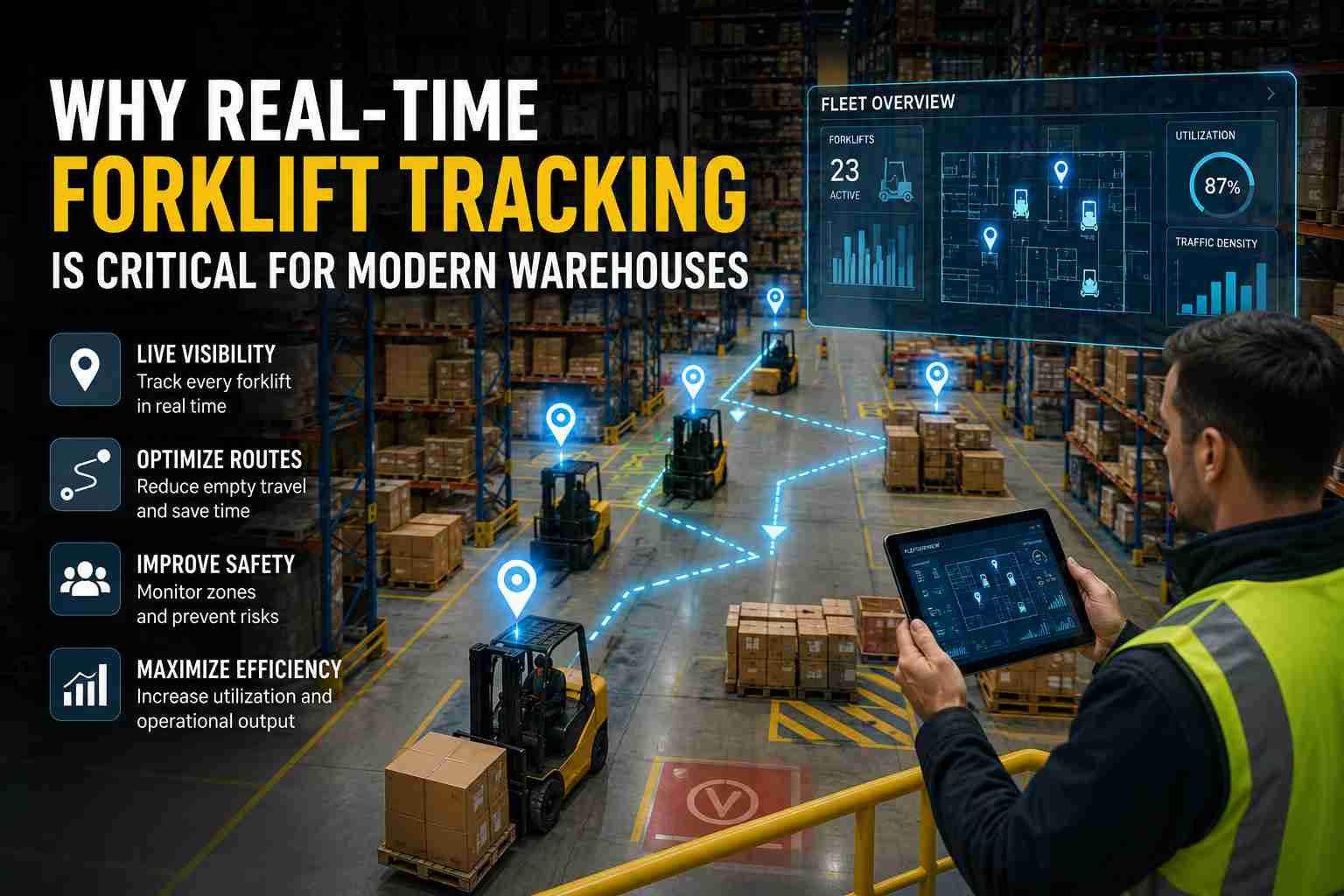
From an elevated supervisor window, the entire floor looks like a model of high-efficiency throughput. But if you analyze the underlying operations logs, you will quickly find a massive structural leak draining your daily profit margins.
Material handling trucks routinely cross hundreds of thousands of square feet completely empty. Drivers drop off a load at a far-flung storage bay and drive right past a high-priority pick requirement because they have no direct line of sight to the changing demand.
Modern Approach to Forklift Tracking and Safety
Traditional warehouse management platforms cannot fix these efficiency leaks because they operate entirely on a transactional time lag. The software records exactly when an operator scans a barcode at an intake rack and when that same SKU gets registered into a shipping ledger.
What happens to the vehicle between those physical scans remains completely dark. When scheduling tools are blind to the immediate real-world coordinates of your machinery, they hand out tasks based on rigid chronological lists rather than absolute floor proximity.
This is where RTLS steps in: integrating Real-Time Forklift Tracking bridges this coordination gap permanently by feeding continuous position updates straight into your facility’s scheduling logic. Instead of forcing operators to waste critical shift minutes hunting supervisors or driving back to central dispatch desks for instructions, the building infrastructure delivers automated tasks on the fly.
This upgrade changes your layout from an unpredictable environment into an engineered network where assignments go to the closest available truck.
Cutting off Friction of Blind Vehicle Movements
The single biggest hit to financial performance inside a high-density transit facility is a utilization failure known on the floor as deadheading. Without a steady stream of spatial tracking indicators, industrial trucks spend a significant portion of their active battery life or fuel runtime traveling without a payload. An operator unloads a pallet at the perimeter of the grid and travels all the way back across the building simply because the central software has no way of knowing they are currently idling right next to an urgent outbound pick requirement.
Deploying live fleet positioning updates eliminates this blind spot completely, allowing your enterprise database to orchestrate travel patterns based on true proximity.
- Proximity Task Interleaving: Automatically deliver the next pick order to the nearest available driver for the exact second they execute a drop-off, dropping empty travel distances to a bare minimum.
- Aisle Traffic Balancing: Track live equipment densities across narrow storage rows to catch vehicle clustering early, letting dispatchers adjust paths before a traffic jam stalls production lines.
- Granular Turnaround Metrics: Measure exactly how many minutes a truck spends sitting idle inside a trailer bed versus moving across the main floor, pinpointing hidden delays during dock loading cycles.
By tying live location metrics to dynamic assignment queues, you stop burning machine hours and driver labor on empty transit runs. This structural adjustment slashes daily equipment maintenance expenses while driving up your total pallets-handled-per-hour capabilities.
Exposing Fleet Hoarding and Right-Sizing Capital Overhead
When operations directors lack clear, objective metrics detailing how their material handling fleets move; they tend to over-correct by leasing or purchasing extra machinery to handle peak cycles. If a specific department complains about material arrival delays, the standard corporate response is to request more reach trucks or add sit-down forklifts to keep local teams happy.
This approach inflates your equipment overhead while leaving the real operational workflow bottlenecks completely untouched. Continuous fleet visibility reveals the objective truth behind machine utilization, exposing where assets are truly moving loads versus where they are simply parked or caught in traffic bottlenecks.
Live tracking makes it easy to isolate ghost assets, revealing vehicles that sit idle in unmapped corners or are hoarded by specific shifts to safeguard local targets. Reviewing historical coordinate data lets you execute precise fleet right-sizing, allowing you to confidently return unneeded equipment when lease contracts expire.
Furthermore, you can achieve predictive maintenance syncing by pairing real-world travel distances and engine runtimes with maintenance schedules to service equipment based on exact wear rather than arbitrary calendar dates.
When every forklift is tracked to the inch, you gain the operational leverage to run a leaner, more precise fleet, squeezing maximum productivity out of fewer physical assets.
Overcome Signal Barriers Without Vendor Lock-In
A major challenge when rolling out large-scale tracking projects is engineering around the hostile physics of a fulfillment warehouse. High-density steel storage racks, stacked metallic pallets, and moving overhead infrastructure create an aggressive environment that easily deflects and absorbs standard wireless signals.
Overcoming these physical barriers requires a highly strategic layout design, but it should never require getting trapped in a closed, single-vendor hardware monopoly. Many tracking providers lock their management platforms to their own expensive, proprietary active tags, making it financially impossible to scale across multiple distribution centers.
Building a future-proof tracking network demands a technology-agnostic architecture in your data layer. A tight cross-dock cell handling specialized high-value inventory might require the sub-inch precision of Ultra-Wideband anchors, while your standard bulk storage lanes or outdoor trailer yards can run efficiently on Bluetooth Low Energy or standard Wi-Fi setups. Unifying these varied hardware streams through an open RTLS framework keeps your upfront infrastructure costs manageable while ensuring your tracking network can scale naturally as your logistics footprint grows.
Bottom-Line: Risk-Free Fleet Tracking and Safety
LocaXion is the world’s first pure-play RTLS & Digital Twin systems integrator. We engineer systems for your business outcomes-not just “tracking.”
That means less risk, less integration of guesswork, and faster time-to-value. And because we’re not locked to one technology stack, you get the freedom to scale with the right technology – not the technology we happen to sell.
RTLS tracks your assets. LocaXion transforms how your operation runs.
That’s the difference. And it’s not a small one.
Stop wasting margins on empty vehicle travel and engineer your outcomes today at https://locaxion.com/
More Details : Quantic School of Business and Technology: A Complete Guide

Immediate Loading Implants: How “Fixed Teeth in 48 Hours” Really Works

How UK Mobile Proxies Help Businesses Test Their Websites

Gen AI in Supply Chain: Using Supply Chain Benchmarks to Improve Performance

What Is the UK Theory Test? How It Works, Cost and Pass Mark

Weather the Storm: Why Totally Branded Umbrellas are the UK’s Most Appreciated Gift

How to Store, Wind, and Travel With Your Automatic Watch Collection Without Damaging It

What Do HubSpot Onboarding Services Include?

AI in Supply Chain: How AI Consulting Services Help Build More Intelligent and Resilient Operations

Hungary Dental Tourism: Quality Dental Care at Affordable Prices

Timur Turlov: A Vision for the Future of Global Chess
How to Store, Wind, and Travel With Your Automatic Watch Collection Without Damaging It
What Is the UK Theory Test? How It Works, Cost and Pass Mark
Weather the Storm: Why Totally Branded Umbrellas are the UK’s Most Appreciated Gift
Gen AI in Supply Chain: Using Supply Chain Benchmarks to Improve Performance
How UK Mobile Proxies Help Businesses Test Their Websites
Immediate Loading Implants: How “Fixed Teeth in 48 Hours” Really Works
Immediate Loading Implants: How “Fixed Teeth in 48 Hours” Really Works
How UK Mobile Proxies Help Businesses Test Their Websites
Gen AI in Supply Chain: Using Supply Chain Benchmarks to Improve Performance
What Is the UK Theory Test? How It Works, Cost and Pass Mark
Weather the Storm: Why Totally Branded Umbrellas are the UK’s Most Appreciated Gift
How to Store, Wind, and Travel With Your Automatic Watch Collection Without Damaging It
What Do HubSpot Onboarding Services Include?
AI in Supply Chain: How AI Consulting Services Help Build More Intelligent and Resilient Operations
Hungary Dental Tourism: Quality Dental Care at Affordable Prices
Timur Turlov: A Vision for the Future of Global Chess
-

 Tech8 months ago
xxx is equal to 2022: A Complete Informative Explanation of a Cubic Equation
-

 Celebrity8 months ago
Izzie Balmer Partner: A Deep Dive into the Relationship with Will Hawley
-

 Entertainment8 months ago
The Artistic World of Gege Akutami: A Mastermind Behind Jujutsu Kaisen
-

 Food5 months ago
Best Sushi Rice Brands: A Complete Guide to Choosing the Right Rice for Sushi