
Business
Business Process Improvement: How Digital Transformation Consulting Drives Enterprise Efficiency

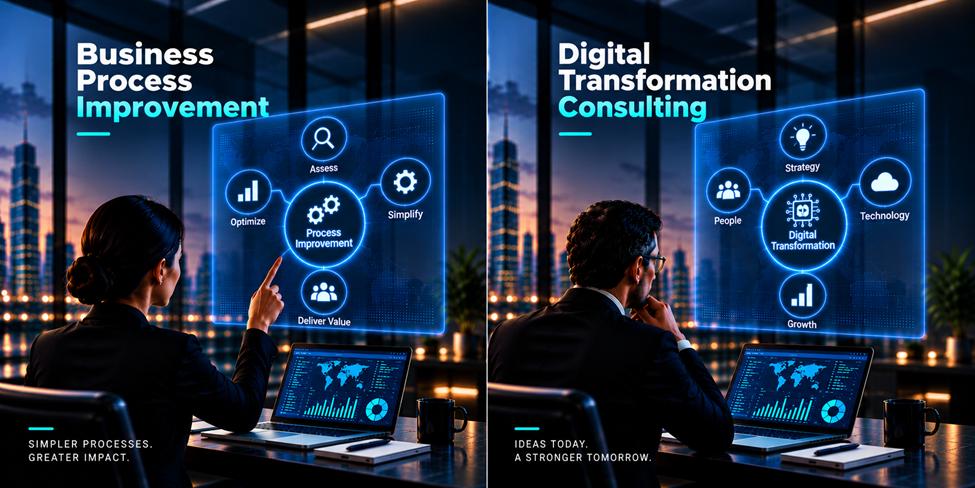
Organizations face growing pressure to reduce operating costs, improve productivity and deliver consistent services while responding to changing business requirements. Inefficient workflows, fragmented technology and manual activities can limit performance and increase operational complexity. Business process improvement provides a structured approach to identifying and addressing these inefficiencies, while digital transformation consulting helps organizations apply technology and operating model changes to achieve sustainable results.
Combining these disciplines enables organizations to redesign processes rather than simply automate existing activities. The objective is to improve how work is performed, strengthen decision-making and create measurable enterprise value.
This article explores how business process improvement and digital transformation consulting work together, their applications, benefits and priorities for successful implementation.
What is business process improvement?
Business process improvement is the systematic evaluation and redesign of organizational workflows to improve efficiency, quality, speed and business outcomes.
It involves examining how activities move across employees, departments and technology systems to identify unnecessary steps, bottlenecks, duplication and control issues.
Improvement initiatives may include process standardization, automation, clearer accountability and changes to operating models.
The objective is not simply to accelerate existing work but to ensure processes deliver the intended outcomes with fewer resources and less complexity.
What is digital transformation consulting?
Digital transformation consulting helps organizations modernize business processes, technology environments and operating models through digital capabilities.
Consultants assess existing performance, identify technology and process gaps and develop implementation roadmaps aligned with enterprise priorities.
Services can include process redesign, enterprise application modernization, cloud, data analytics, artificial intelligence, intelligent automation and workforce transformation.
Digital transformation consulting connects these capabilities with business objectives so technology investments address meaningful performance challenges.
Why process improvement should come before automation
Organizations sometimes introduce new technology without examining whether existing workflows are efficient.
Automating unnecessary approvals, duplicated activities or inconsistent processes can preserve underlying inefficiencies.
Business process improvement helps organizations identify which steps should be simplified, standardized or eliminated before technology is introduced.
Digital transformation consulting can then determine which capabilities are appropriate for the redesigned process.
This approach reduces the risk of digitizing complexity and helps organizations achieve stronger operational outcomes.
Key stages of business process improvement
A structured improvement approach typically includes several stages.
Assess current performance
Organizations begin by evaluating existing processes, costs, productivity, cycle times and service outcomes.
Identify performance gaps
Internal analysis and external benchmarking can reveal where processes underperform.
Analyze root causes
Teams investigate unnecessary activities, fragmented systems, manual handoffs and unclear ownership.
Redesign workflows
Processes are simplified and standardized around clearly defined business outcomes.
Implement technology
Automation, analytics and AI can support the redesigned process where appropriate.
Measure results
Organizations monitor performance to determine whether expected improvements are being realized.
Digital transformation consulting can support these stages through strategy, technology expertise and implementation planning.
Where process improvement creates enterprise value
Business process improvement can support multiple business functions.
Finance
Organizations can improve invoice processing, reconciliations, financial reporting and other finance activities.
Human resources
Process redesign can simplify onboarding, employee administration, HR case management and workforce services.
Procurement
Improvement initiatives can reduce sourcing cycle times, simplify purchasing and strengthen supplier processes.
Supply chain
Organizations can improve planning, inventory management, manufacturing and logistics workflows.
Information technology
Process improvement can strengthen service management, software delivery and technology operations.
Customer operations
Redesigned workflows can accelerate issue resolution and improve customer service consistency.
These applications demonstrate why process improvement should be considered an enterprise capability.
Business benefits of digital transformation consulting
When aligned with process improvement objectives, digital transformation consulting can support several benefits.
Greater productivity
Simplified workflows and automation can reduce repetitive work and improve employee capacity.
Lower operating costs
Removing unnecessary activities and improving resource utilization can reduce operational expenses.
Faster process execution
Standardized workflows can reduce delays, manual handoffs and processing times.
Improved service quality
Clearer processes and better information can support more consistent business services.
Greater scalability
Digital processes can help organizations manage increasing workloads without proportional growth in administrative resources.
How digital transformation consulting supports process redesign
Organizations often have multiple improvement opportunities but limited investment capacity.
Digital transformation consulting can help leadership teams prioritize initiatives according to business impact, feasibility and implementation complexity.
Consultants can assess current processes, identify performance gaps and determine which technology investments are required.
For example, an organization experiencing lengthy invoice processing cycles may need to simplify approval rules before introducing advanced automation.
This ensures business process improvement addresses underlying causes rather than only symptoms.
The role of AI and automation
Artificial intelligence and automation are expanding the possibilities for process improvement.
Intelligent automation can execute repetitive activities, while machine learning can identify patterns and anomalies.
Generative AI can summarize information, retrieve enterprise knowledge and support employees with knowledge-intensive tasks.
AI agents may eventually coordinate multistep workflows across enterprise systems.
However, technology should be introduced only when it supports clearly defined process outcomes.
Digital transformation consulting can help organizations determine where intelligent capabilities create sufficient value to justify implementation.
Best practices for business process improvement
Organizations can strengthen improvement initiatives by following several principles:
- Start with clearly defined business problems and expected outcomes.
- Establish current performance baselines.
- Identify root causes before selecting technology solutions.
- Simplify and standardize processes where appropriate.
- Improve enterprise data quality and accessibility.
- Prioritize initiatives based on value, feasibility and risk.
- Integrate technology with redesigned workflows.
- Establish clear process ownership and governance.
- Prepare employees for changes in responsibilities.
- Continuously measure financial and operational outcomes.
These practices help organizations maintain a clear connection between process improvement and business value.
Common transformation challenges
Fragmented processes can make improvement difficult when activities span multiple departments or business units.
Legacy technology may restrict integration and limit opportunities for automation.
Inconsistent data can also reduce the reliability of performance analysis.
Another challenge is organizational resistance. Employees may be accustomed to existing workflows and require training or support when processes change.
Digital transformation consulting can help organizations address these challenges through structured planning and implementation.
Measuring the value of process improvement
Successful initiatives should be evaluated through measurable operational and financial outcomes.
Relevant metrics can include process cycle time, employee productivity, operating costs, error rates, service quality and customer satisfaction.
Organizations should establish baselines before implementation and compare actual results with expected improvements.
Business process improvement should also be evaluated over time to determine whether benefits remain sustainable.
This helps leadership teams identify which initiatives should be expanded and where additional redesign may be required.
The future of process improvement
Business process improvement will increasingly combine process analytics, intelligent automation and AI-enabled decision support.
Organizations may use advanced analytics to identify bottlenecks and monitor performance continuously.
AI agents could support approved workflows across enterprise applications, reducing manual coordination.
As these capabilities mature, digital transformation consulting will increasingly focus on redesigning operating models around intelligent processes.
The objective will remain consistent: improve business performance through simpler, more effective ways of working.
Conclusion
Business process improvement provides the foundation for reducing operational complexity, improving productivity and strengthening service delivery.
Digital transformation consulting connects these improvements with technology modernization, automation and enterprise operating model changes.
Organizations that prioritize process redesign, reliable data, effective governance and measurable outcomes will be better positioned to achieve sustainable efficiency improvements and build scalable, high-performing operations.

Glass Works: A Guide to Crittall Doors, Glass Partitions and Glass Walls

Business Process Improvement: How Digital Transformation Consulting Drives Enterprise Efficiency

12 Best Omegle Alternatives for Random Video Chat and Meeting New People

Dbxbqm Meaning: Why It Appears When You Try to Type YouTube

Immediate Loading Implants: How “Fixed Teeth in 48 Hours” Really Works

How UK Mobile Proxies Help Businesses Test Their Websites

Gen AI in Supply Chain: Using Supply Chain Benchmarks to Improve Performance

What Is the UK Theory Test? How It Works, Cost and Pass Mark

Weather the Storm: Why Totally Branded Umbrellas are the UK’s Most Appreciated Gift

How to Store, Wind, and Travel With Your Automatic Watch Collection Without Damaging It
Immediate Loading Implants: How “Fixed Teeth in 48 Hours” Really Works
How UK Mobile Proxies Help Businesses Test Their Websites
12 Best Omegle Alternatives for Random Video Chat and Meeting New People
Dbxbqm Meaning: Why It Appears When You Try to Type YouTube
Business Process Improvement: How Digital Transformation Consulting Drives Enterprise Efficiency
Glass Works: A Guide to Crittall Doors, Glass Partitions and Glass Walls
Glass Works: A Guide to Crittall Doors, Glass Partitions and Glass Walls
Business Process Improvement: How Digital Transformation Consulting Drives Enterprise Efficiency
12 Best Omegle Alternatives for Random Video Chat and Meeting New People
Dbxbqm Meaning: Why It Appears When You Try to Type YouTube
Immediate Loading Implants: How “Fixed Teeth in 48 Hours” Really Works
How UK Mobile Proxies Help Businesses Test Their Websites
Gen AI in Supply Chain: Using Supply Chain Benchmarks to Improve Performance
What Is the UK Theory Test? How It Works, Cost and Pass Mark
Weather the Storm: Why Totally Branded Umbrellas are the UK’s Most Appreciated Gift
How to Store, Wind, and Travel With Your Automatic Watch Collection Without Damaging It
-

 Tech9 months ago
xxx is equal to 2022: A Complete Informative Explanation of a Cubic Equation
-

 Celebrity9 months ago
Izzie Balmer Partner: A Deep Dive into the Relationship with Will Hawley
-

 Entertainment9 months ago
The Artistic World of Gege Akutami: A Mastermind Behind Jujutsu Kaisen
-

 Food6 months ago
Best Sushi Rice Brands: A Complete Guide to Choosing the Right Rice for Sushi