
How to
How to Store, Wind, and Travel With Your Automatic Watch Collection Without Damaging It

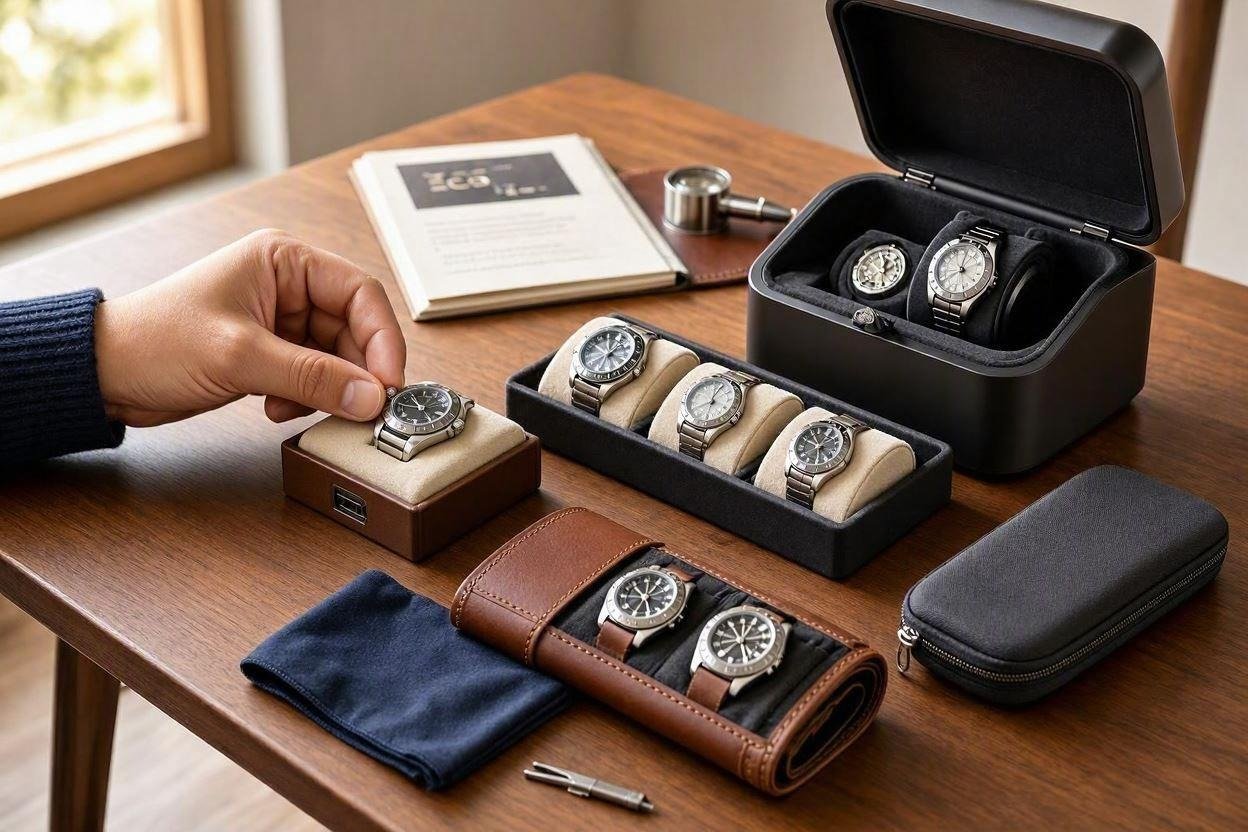
Building a collection of automatic watches is the easy part. Looking after it properly is where most owners go wrong. A watch that costs several thousand pounds can still lose accuracy, gather moisture, or pick up scratches if it spends its downtime rattling around in a drawer or getting stuffed into a suitcase alongside socks and chargers.
The good news is that protecting your watches doesn’t require a safe or a climate-controlled room. It requires understanding a few basics about how automatic movements behave when they’re not on your wrist, and choosing the right storage and travel gear for the way you actually live.
This guide walks through home storage, winding, humidity control, and travel, so your collection stays accurate and scratch-free whether it’s sitting in your bedroom or crossing three time zones with you.
Why Automatic Watches Need More Care Than Quartz
A quartz watch runs on a battery and barely notices neglect. An automatic movement is a different story. It relies on a mainspring that winds itself as your wrist moves, and once you take the watch off, that spring starts to unwind. Depending on the model, a watch will typically stop running somewhere between 38 and 70 hours after you last wore it.
That matters for two reasons. First, a stopped mechanical watch needs to be reset and often re-synced before you wear it again, which is a minor annoyance if you own one watch and a genuine time drain if you own six. Second, and more importantly, mechanical components that sit static for long stretches without any lubrication movement can develop stiffness in the oils over time, particularly if the watch is stored in a cold or damp environment.
None of this means your watches are fragile. It means they respond well to a bit of routine, the same way a car runs better when it’s driven regularly rather than left in a garage for months.
Everyday Storage: Getting the Basics Right
For a single watch worn daily, storage is barely a consideration. Problems start once you have three, five, or a dozen pieces rotating in and out of use.
Keep watches off flat, hard surfaces. A watch left face-down on a wooden dresser or bathroom shelf picks up hairline scratches on the crystal and case back far more easily than most people expect. A dedicated tray, cushion, or watch roll adds a soft barrier between the watch and whatever surface it’s resting on.
Separate watches from each other. Two watches thrown into the same drawer will knock against one another every time the drawer opens. Steel bracelets are particularly good at scuffing gold-toned cases and inflicting the odd scratch on sapphire crystal.
Control light and temperature. Direct sunlight can fade dial colours and degrade leather straps over months. A cupboard or drawer away from a window is a better long-term home than a windowsill display, however nice it looks.
This is where a dedicated watch roll earns its keep. If you travel or rotate watches between a home safe and a desk drawer, you can browse Aevitas leather watch rolls built specifically to keep each piece cushioned and separated, whether you’re storing two watches or six.
Should You Wind Your Watch by Hand?
If you take a watch off for a day or two and don’t want to reset the time and date when you put it back on, manual winding is the simplest fix. Most automatic watches can be hand-wound by turning the crown clockwise 20 to 30 times, which gives the mainspring enough tension to keep running for a day even before your wrist takes over.
There are a couple of exceptions worth knowing. Some watches, particularly certain vintage pieces, have a decoupled winding mechanism where the crown doesn’t directly wind the mainspring, and hand-winding either does nothing or requires a specific technique. If you’re unsure, the watch’s manual or manufacturer will confirm whether hand-winding is supported.
Hand-winding is fine for occasional use. It becomes tedious fast if you own several watches you wear on rotation, which is exactly the problem a watch winder is designed to solve.
When a Watch Winder Actually Makes Sense
A watch winder is a small motorised box that rotates a watch on your behalf, mimicking the movement of a wrist so the mainspring stays wound even when the watch isn’t being worn. It’s a genuinely useful tool in a few specific situations, and unnecessary in others.
A winder makes sense if:
- You own a watch with a perpetual calendar or complicated date function that’s genuinely annoying to reset
- You rotate between three or more automatic watches and don’t want to reset each one every time you switch
- You want to display your collection in a way that also keeps it running
A winder is probably unnecessary if you wear the same one or two watches most days and don’t mind a quick reset when you pick up a piece you haven’t worn in a while.
Not all winders are built the same. Cheap models can rotate too fast, too slow, or in the wrong direction for a specific movement, which does nothing useful and can theoretically add unnecessary wear over the long run. It’s worth understanding the differences before buying one, and this breakdown of the best watch winder brands covers rotation settings, turns-per-day requirements, and which brands handle different movement types well.
Humidity, Moisture, and Why It Matters More Than People Think
Watches are generally water-resistant to some degree, but water-resistance ratings apply to the watch as a sealed unit in short-term contact with water, not to long-term storage in a humid environment. A watch kept in a damp bathroom cabinet or a basement without ventilation is at real risk of moisture creeping past gaskets over time, which can fog the crystal from the inside or, worse, reach the movement.
A simple silica gel packet in a watch box or drawer absorbs excess moisture cheaply and effectively. If you live somewhere genuinely humid, a small dehumidifier in the room where you store your collection is a worthwhile investment, particularly for pieces with leather straps, which absorb moisture and can develop mould in bad conditions. According to the Smithsonian’s guidance on caring for mechanical objects, stable humidity is one of the most reliable ways to protect precision instruments from long-term corrosion, and the same principle applies directly to watch movements.
Travelling With Your Watches Without Ruining Them
Travel is when most watch damage actually happens, not sitting at home. Suitcases get thrown, checked baggage gets handled roughly, and a watch loose in a toiletry bag or wrapped in a t-shirt has no real protection.
A few practical rules make a real difference:
Never check watches in hold luggage. Temperature swings in an aircraft hold, plus rough handling, are a bad combination for anything mechanical or valuable. Keep watches in carry-on luggage, on your person if possible.
Use a case, not a pocket. A dedicated travel case with individual cushioned slots stops watches from knocking against each other and against harder items in your bag. It’s the travel equivalent of the drawer separation issue at home, just under far rougher conditions.
Think about the trip length, not just the destination. For a weekend away with one or two watches, a compact roll is usually enough. For longer trips where you’re bringing a genuine rotation, look at capacity and padding rather than just style. This is a good moment to check the full Aevitas UK store for cases sized to how many pieces you actually travel with, rather than buying based on looks alone.
Pack straps separately if they’re leather. Extreme temperature changes, like a hot car boot or a cold overhead locker, can dry out or warp leather over repeated trips. A watch roll with individual compartments keeps straps from rubbing against metal cases during transit.
A Simple Routine That Covers Most of This
You don’t need a complicated system to keep a small collection in good shape. A practical routine looks something like this: store watches separately, out of direct sunlight, with basic humidity control if your climate calls for it. Hand-wind or use a winder for pieces you’re not wearing daily, based on how often you rotate them. When travelling, use a proper case and keep watches in your carry-on, not checked luggage.
None of this is expensive or time-consuming once it’s a habit. It’s the same principle as maintaining a car or a bike: small, consistent care prevents the bigger problems that come from neglect.
Final Thoughts
Automatic watches reward a bit of attention. They’re mechanical objects built to be worn, wound, and occasionally serviced, not left untouched in a drawer for months at a time. Getting the basics right, separate storage, sensible humidity control, appropriate winding, and proper travel protection, adds years to how well a watch performs and how good it looks doing it.
None of this needs to be complicated. A decent watch roll, a sensible approach to winding, and a bit of care when you travel will keep a collection running well for decades, which is usually the whole point of buying a mechanical watch in the first place.
FAQs
How long can an automatic watch sit unworn before it stops? Most automatic watches will stop somewhere between 38 and 70 hours after being taken off, depending on the movement’s power reserve. Checking your specific model’s spec sheet gives you an exact figure.
Is it bad to manually wind an automatic watch? No, hand-winding is safe for the vast majority of automatic watches and is actually the intended way to start a fully stopped watch. The main exception is certain vintage or specialty movements where the manufacturer specifically advises against it.
Do I need a watch winder if I only own two watches? Not necessarily. If you’re happy resetting the time and date occasionally, two watches are easy enough to manage by hand-winding. A winder becomes more useful once resetting becomes a regular hassle, particularly with complicated date functions.
Can humidity actually damage a watch that’s water-resistant? Yes, over the long term. Water-resistance ratings are designed for short-term exposure, not prolonged storage in damp conditions. Consistent humidity can gradually affect gaskets, leather straps, and in worst cases the movement itself.
What’s the safest way to pack watches for a flight? Keep them in carry-on luggage rather than checked bags, ideally in a padded travel case with individual compartments so they’re not moving around or knocking against each other during handling.

12 Best Omegle Alternatives for Random Video Chat and Meeting New People

Dbxbqm Meaning: Why It Appears When You Try to Type YouTube

Immediate Loading Implants: How “Fixed Teeth in 48 Hours” Really Works

How UK Mobile Proxies Help Businesses Test Their Websites

Gen AI in Supply Chain: Using Supply Chain Benchmarks to Improve Performance

What Is the UK Theory Test? How It Works, Cost and Pass Mark

Weather the Storm: Why Totally Branded Umbrellas are the UK’s Most Appreciated Gift

How to Store, Wind, and Travel With Your Automatic Watch Collection Without Damaging It

What Do HubSpot Onboarding Services Include?

AI in Supply Chain: How AI Consulting Services Help Build More Intelligent and Resilient Operations
Immediate Loading Implants: How “Fixed Teeth in 48 Hours” Really Works
How UK Mobile Proxies Help Businesses Test Their Websites
12 Best Omegle Alternatives for Random Video Chat and Meeting New People
Dbxbqm Meaning: Why It Appears When You Try to Type YouTube
12 Best Omegle Alternatives for Random Video Chat and Meeting New People
Dbxbqm Meaning: Why It Appears When You Try to Type YouTube
Immediate Loading Implants: How “Fixed Teeth in 48 Hours” Really Works
How UK Mobile Proxies Help Businesses Test Their Websites
Gen AI in Supply Chain: Using Supply Chain Benchmarks to Improve Performance
What Is the UK Theory Test? How It Works, Cost and Pass Mark
Weather the Storm: Why Totally Branded Umbrellas are the UK’s Most Appreciated Gift
How to Store, Wind, and Travel With Your Automatic Watch Collection Without Damaging It
What Do HubSpot Onboarding Services Include?
AI in Supply Chain: How AI Consulting Services Help Build More Intelligent and Resilient Operations
-

 Tech9 months ago
xxx is equal to 2022: A Complete Informative Explanation of a Cubic Equation
-

 Celebrity9 months ago
Izzie Balmer Partner: A Deep Dive into the Relationship with Will Hawley
-

 Entertainment9 months ago
The Artistic World of Gege Akutami: A Mastermind Behind Jujutsu Kaisen
-

 Food6 months ago
Best Sushi Rice Brands: A Complete Guide to Choosing the Right Rice for Sushi