
Entertainment
Bison Movie Review: Kabaddi, Caste, and the Weight of Strength in Mari Selvaraj’s Fierce Sports Drama

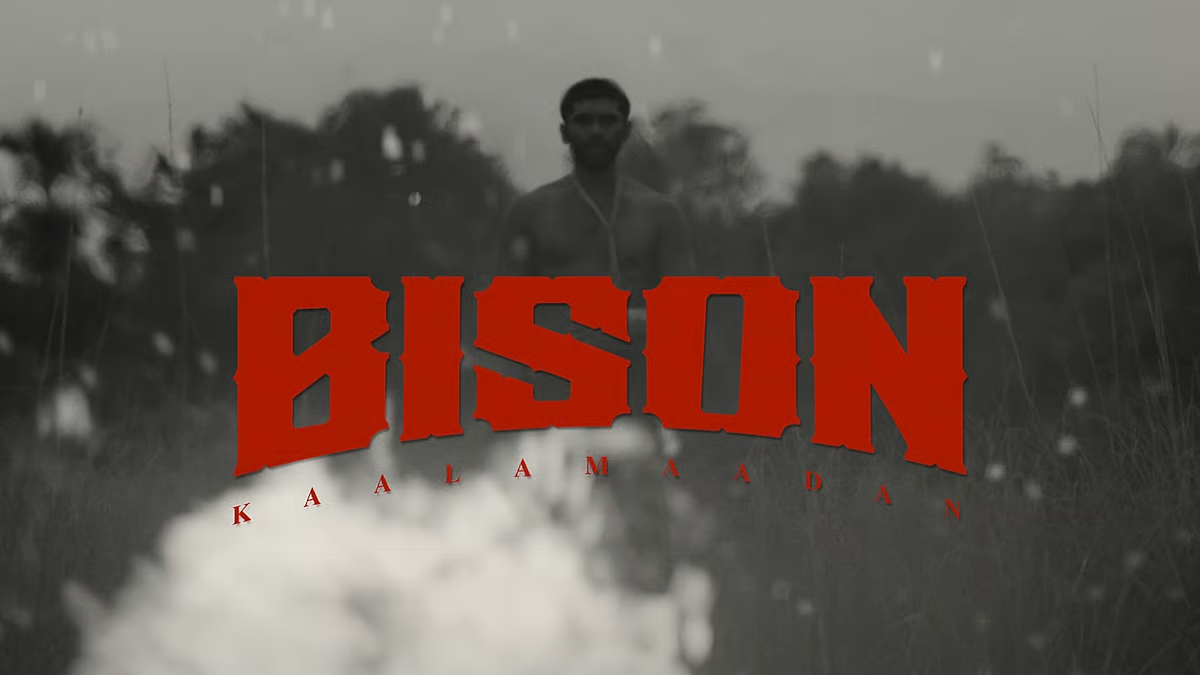
Most sports dramas are about victory, comeback, aur personal grit. But the bison movie refuses to stay inside those comfortable boundaries. Directed by Mari Selvaraj, this film uses sport not as the destination, but as a weapon to explore caste, rage, masculinity, and survival in rural India. Kabaddi yahan sirf ek game nahi hai — yeh ek metaphor hai.
The Power of the Opening Sequence
The film opens in 1994 with a grainy Doordarshan broadcast from the Asian Games in Japan. A village gathers early in the morning, eyes fixed on the screen, waiting to see their local boy Kittan play Kabaddi. The excitement collapses when they realise he has been benched again.
This opening sets the emotional tone of the bison movie immediately — waiting, denial, frustration, and quiet humiliation. The flickering black-and-white visuals mirror Kittan’s stuck life, unable to move forward despite effort.
Colour as Memory, Not Escape
Interestingly, the black-and-white is not used for flashbacks. When the film moves into Kittan’s past, the screen bursts into colour. His memories are vivid, sharp, and heavy. They don’t fade with time — they fuel him.
This visual choice is one of the smartest storytelling tools in the bison movie, showing that Kittan’s past is not something he escapes from, but something he runs with.
Inspired by a Real-Life Kabaddi Player
The story is inspired by the life of Manathi Ganesan, a Kabaddi player nicknamed “Bison” because of his raw physical strength. However, the bison movie is not interested in factual biography. Instead, it focuses on the emotional and social forces that shape a sportsman long before he steps onto the mat.
Kittan’s childhood is marked by his mother’s death and a father paralysed by fear. His father believes invisibility is safety — a belief common in families that have survived generations of oppression.
A Life Pre-Decided by Hierarchy
Through layered flashbacks, the bison movie exposes how Kittan’s worth is measured by social rankings. He is poor, Dalit, motherless, introverted, Tamil-speaking, and undereducated. In a deeply hierarchical society, these labels define expectations before talent is even considered.
The film makes it painfully clear: for people like Kittan, survival is the only ambition society allows.
Violence as a Way of Life
The village Kittan grows up in is soaked in violence. A long-standing feud between Pandiaraja and Kandasamy has turned rage into routine. Knives flash casually, murders erupt over minor slights, and fear hangs permanently in the air.
One of the most powerful lines in the bison movie comes from Kittan’s sports teacher: “Nobody knows whether we will pick up the knife, or whether time will hand it to us.” Violence here is not choice — it is inheritance.
Dhruv Vikram’s Controlled and Physical Performance
Dhruv Vikram delivers one of his most disciplined performances as Kittan. His body grows stronger with training, but his eyes constantly fight restraint. This is a man terrified of what his strength could become if unleashed.
A recurring motif in the bison movie is Kittan running. Whenever he is denied something or unable to express himself, he runs — through streets, playgrounds, highways. Each run carries a different emotion: anger, confusion, escape, resistance.
Kabaddi as a Metaphor for Life
Kabaddi is not just a sport in the bison movie — it mirrors Kittan’s existence. Every time he tries to step “out” of his assigned place in society, unseen hands pull him back. His life becomes one long raid where escape is never guaranteed.
This metaphor is powerful and consistently reinforced without verbal explanation.
Heavy-Handed Messaging and Narrative Excess
While the film’s intentions are strong, the bison movie sometimes overstates its message. The background score is often disruptive, pushing emotions that the visuals already communicate. Certain dialogues feel too on-the-nose.
A spinning monologue scene involving Kandasamy aims for epic mythological weight but doesn’t fully earn its emotional payoff. The long runtime allows these indulgences to stretch more than necessary.
Underwritten Female Characters
One of the film’s biggest weaknesses lies in its female characters. Rajisha Vijayan’s Raji, Kittan’s sister, exists largely as emotional support. Anupama Parameswaran’s Rani loves Kittan from childhood, but the relationship never deepens enough to feel transformative.
For a film that examines social structures so sharply, this absence feels noticeable.
A Shift Toward Mainstream Emotional Appeal
As the story returns to the Asian Games match, colour re-enters the frame along with waving Indian flags. The final Kabaddi match is India vs Pakistan, and the film’s language shifts toward Hindi and Urdu, aiming for pan-Indian emotional resonance.
This tonal shift in the bison movie may feel powerful to some and calculated to others, depending on what the viewer expects going in.
Connection to Mari Selvaraj’s Larger Filmography
The film ends around 1995, placing it in the same timeline and region as Selvaraj’s Karnan. Together, these films act as companion pieces, showing that breaking caste hierarchies is not a single victory but an ongoing struggle.
The bison movie reinforces the idea that even when one battle is won, the war continues.
Final Verdict
The bison movie is intense, uneven, politically charged, and emotionally exhausting — but it is also deeply sincere. It may not offer the clean triumph of traditional sports dramas, but it delivers something far more unsettling and honest.
This is not just a story about becoming strong enough to win.
It is about surviving a world that never wanted you to play.
More Details : Whatutalkingboutwillis Gifts: A Complete Guide to Thoughtful, Fun, and Meaningful Gifting

How to Store, Wind, and Travel With Your Automatic Watch Collection Without Damaging It

What Do HubSpot Onboarding Services Include?

AI in Supply Chain: How AI Consulting Services Help Build More Intelligent and Resilient Operations

Hungary Dental Tourism: Quality Dental Care at Affordable Prices

Timur Turlov: A Vision for the Future of Global Chess

Meaningful Ways to Memorialise a Beloved Pet After Loss

Understanding Jerking Movements: An Ayurvedic Perspective

Are You Saving Enough for Retirement? Key Benchmarks by Age

Timur Turlov: A Visionary Leader Transforming Modern Finance

5 Ways a Probate Attorney Can Help When Estate Documents Are Missing
What Do HubSpot Onboarding Services Include?
Timur Turlov: A Vision for the Future of Global Chess
Meaningful Ways to Memorialise a Beloved Pet After Loss
Hungary Dental Tourism: Quality Dental Care at Affordable Prices
AI in Supply Chain: How AI Consulting Services Help Build More Intelligent and Resilient Operations
How to Store, Wind, and Travel With Your Automatic Watch Collection Without Damaging It
How to Store, Wind, and Travel With Your Automatic Watch Collection Without Damaging It
What Do HubSpot Onboarding Services Include?
AI in Supply Chain: How AI Consulting Services Help Build More Intelligent and Resilient Operations
Hungary Dental Tourism: Quality Dental Care at Affordable Prices
Timur Turlov: A Vision for the Future of Global Chess
Meaningful Ways to Memorialise a Beloved Pet After Loss
Understanding Jerking Movements: An Ayurvedic Perspective
Are You Saving Enough for Retirement? Key Benchmarks by Age
Timur Turlov: A Visionary Leader Transforming Modern Finance
5 Ways a Probate Attorney Can Help When Estate Documents Are Missing
-

 Tech8 months ago
xxx is equal to 2022: A Complete Informative Explanation of a Cubic Equation
-

 Celebrity7 months ago
Izzie Balmer Partner: A Deep Dive into the Relationship with Will Hawley
-

 Entertainment8 months ago
The Artistic World of Gege Akutami: A Mastermind Behind Jujutsu Kaisen
-

 Entertainment7 months ago
Semana Santa 2026: Dates, Traditions, and Global Celebrations