
Tech
Coalesce SQL: A Clear Guide to Handling NULL Values in Databases

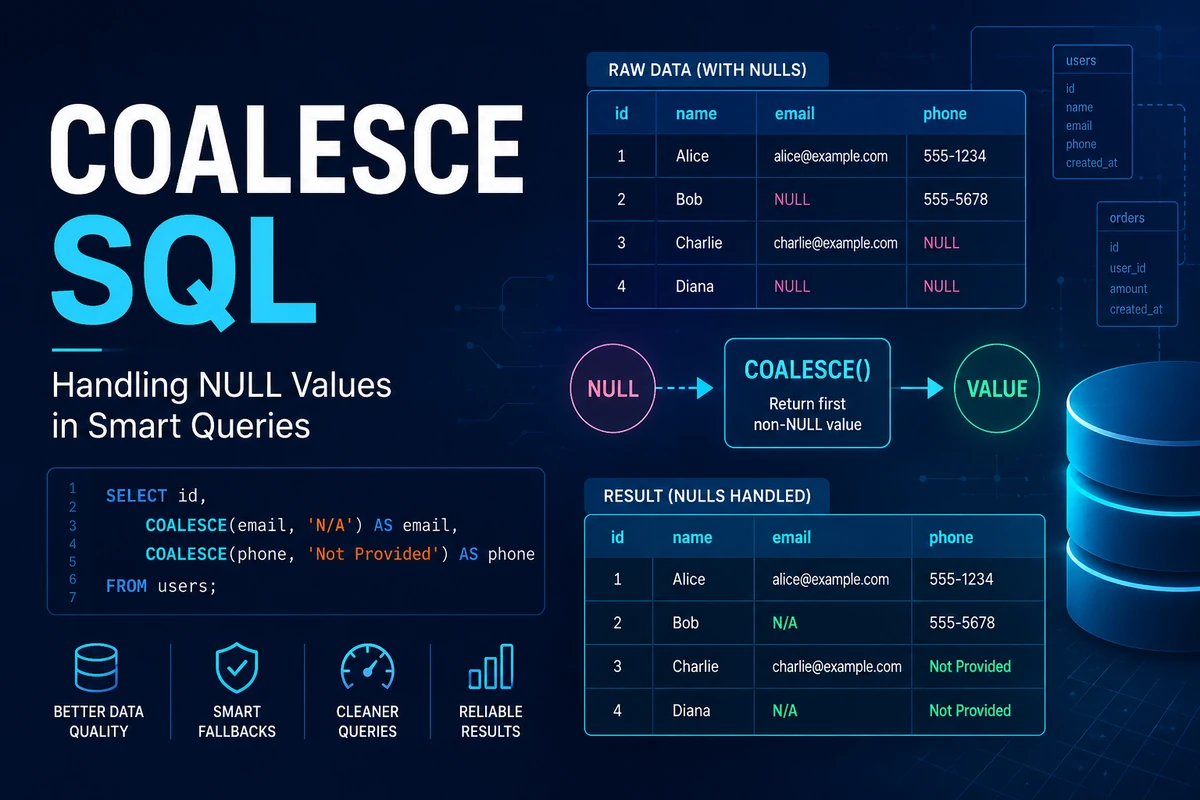
When working with databases, one of the most common problems developers face is dealing with NULL values. A NULL does not mean zero, blank, or false. It means the value is unknown, missing, or not stored. This can create problems in reports, calculations, filters, and user-facing results. That is where coalesce sql becomes useful, because it helps return the first available non-NULL value from a list of options.
What coalesce sql Means
In simple terms, coalesce sql is used to check multiple values in order and return the first one that is not NULL. If the first value is missing, the function checks the next value. If that is also missing, it continues until it finds a valid value. This makes database queries cleaner and more reliable, especially when working with optional fields such as phone numbers, addresses, discounts, middle names, or fallback prices.
Why NULL Values Matter
NULL values can affect query results in surprising ways. For example, adding a number to NULL usually returns NULL, and combining text with NULL may also produce an incomplete result depending on the database system. This can make reports look broken or cause calculations to fail silently. Instead of showing empty or confusing results, COALESCE lets you provide a backup value that makes sense for the user.
Basic Syntax
The basic syntax is easy to understand. You write the function name, then place two or more expressions inside parentheses. The database checks them from left to right and returns the first non-NULL expression.
COALESCE(value1, value2, value3, default_value)If value1 is not NULL, it is returned. If value1 is NULL, the database checks value2. If all listed values are NULL, the function returns NULL unless you include a final default value.
Simple Example
Imagine you have a customers table where some users have a mobile number, some have a home number, and some have only a work number. Instead of writing a long conditional query, you can use COALESCE to choose the best available contact number.
SELECT
    customer_name,
    COALESCE(mobile_phone, home_phone, work_phone, 'No phone available') AS contact_number
FROM customers;
This query first tries to return the mobile phone number. If that is missing, it returns the home phone number. If that is also missing, it returns the work phone number. If none of them exist, it displays “No phone available.”
Why coalesce sql Is Useful in Real Projects
The biggest value of coalesce sql is that it keeps data readable and practical. Real databases are rarely perfect. Users skip fields, old records may be incomplete, and imported data often has missing values. Instead of letting those missing values damage reports or application screens, COALESCE gives you a simple way to add fallback logic directly inside your query.
Using COALESCE With Text
COALESCE is often used with text columns. For example, a user profile may include a display name, username, and email address. If the display name is missing, you may want to show the username. If the username is also missing, you may want to show the email address.
SELECT
    COALESCE(display_name, username, email, 'Unknown user') AS profile_name
FROM users;
This makes the output more user-friendly because the application always has something meaningful to show.
Using COALESCE With Numbers
COALESCE is also helpful in calculations. Suppose an orders table has a discount column, but some rows have NULL instead of zero. If you subtract a NULL discount from the total price, the final amount may become NULL. To avoid that, you can replace NULL with zero.
SELECT
    order_id,
    total_amount - COALESCE(discount_amount, 0) AS final_amount
FROM orders;
This query treats missing discounts as zero, which is usually what businesses expect in order reports.
Using COALESCE With Dates
Date fields are another common place where COALESCE is useful. For example, a task may have a completed date, due date, or created date. If the completed date is missing, you may want to fall back to the due date. If that is also missing, you can use the created date.
SELECT
    task_name,
    COALESCE(completed_at, due_date, created_at) AS important_date
FROM tasks;
This helps create timelines, dashboards, and reports without leaving important date columns empty.
COALESCE and CASE Expressions
COALESCE is often compared to the CASE expression because both can handle conditional logic. A CASE expression gives you more control when conditions are complex, but COALESCE is shorter and easier when the goal is simply to return the first non-NULL value. For basic fallback logic, COALESCE is usually more readable.
SELECT
    COALESCE(nickname, first_name, 'Guest') AS name_to_display
FROM members;
The same result could be written with CASE, but it would require more lines. That is why many developers prefer COALESCE for simple NULL handling.
Coalesce SQL vs ISNULL, IFNULL, and NVL
Different database systems have their own functions for handling NULL values. SQL Server has ISNULL, MySQL has IFNULL, and Oracle has NVL. However, COALESCE is part of the SQL standard and is supported by many popular database systems. Another benefit is that COALESCE can accept more than two values, while some alternatives only accept two arguments.
Important Data Type Rules
One thing to remember is that the values inside COALESCE should usually have compatible data types. For example, mixing numbers, dates, and text in the same function can cause errors or unexpected conversions. Some databases automatically convert values, while others are stricter. To avoid problems, keep your fallback values consistent with the main column type.
Common Mistake With Empty Strings
A common misunderstanding is thinking that COALESCE treats an empty string as NULL. In many databases, an empty string is still a value, not a NULL. For example, if a column contains an empty string, COALESCE may return that empty string instead of moving to the next option. If your data uses empty strings as missing values, you may need to combine COALESCE with NULLIF.
SELECT
    COALESCE(NULLIF(display_name, ''), username, 'Unknown') AS name_to_show
FROM users;
Here, NULLIF(display_name, '') turns an empty display name into NULL, allowing COALESCE to check the next value.
Performance Considerations
COALESCE is generally simple and efficient, but it should still be used carefully in large queries. If you place it around indexed columns inside a WHERE clause, the database may not use indexes as efficiently. For example, filtering with COALESCE(column_name, 'default') can sometimes make the query harder to optimize. In performance-sensitive queries, test the execution plan and consider rewriting the condition if needed.
Best Practices
The best way to use COALESCE is to keep it clear and intentional. Use it when a fallback value improves the result. Avoid stuffing too many unrelated values into one function, because that can make the query difficult to understand. Always choose a default value that matches the meaning of the data. For example, use zero for missing numeric amounts only when zero is truly correct, not just because it removes NULL.
Practical Business Example
Suppose a company stores product pricing in different columns: sale price, special price, and regular price. The sale price should be used first if available. If not, the special price should be used. If neither exists, the regular price should appear.
SELECT
    product_name,
    COALESCE(sale_price, special_price, regular_price) AS display_price
FROM products;
This query is useful for ecommerce websites because it makes sure every product has a price to display, as long as at least one price column has a value.
When Not to Use COALESCE
COALESCE is not always the right solution. If the missing data represents a real data quality issue, hiding it with a default value may create confusion. For example, replacing an unknown shipping date with today’s date could make reports inaccurate. Before adding a fallback value, ask whether the replacement is logically correct or whether the missing data should be fixed at the source.
Final Thoughts
The COALESCE function is one of the most practical tools in SQL because it solves a problem that appears in almost every real database: missing values. It makes queries cleaner, reports easier to read, and application results more reliable. When used correctly, it can reduce messy conditional logic and help you build database output that feels complete, even when some fields are not filled in.
More Details : 15 Powerful Database Optimization Techniques to Boost Performance
FAQs
What is coalesce sql used for?
It is used to return the first non-NULL value from a list of expressions in a SQL query.
Is coalesce sql standard?
Yes. It follows standard SQL and is supported by many major database systems.
Can COALESCE replace CASE?
It can replace CASE when you only need simple fallback logic for NULL values. For complex conditions, CASE is better.
Does COALESCE work with numbers?
Yes. It can work with numbers, text, dates, and other compatible data types.
What happens if all values are NULL?
If every value inside COALESCE is NULL, the result will also be NULL unless you provide a final default value.

12 Best Omegle Alternatives for Random Video Chat and Meeting New People

Dbxbqm Meaning: Why It Appears When You Try to Type YouTube

Immediate Loading Implants: How “Fixed Teeth in 48 Hours” Really Works

How UK Mobile Proxies Help Businesses Test Their Websites

Gen AI in Supply Chain: Using Supply Chain Benchmarks to Improve Performance

What Is the UK Theory Test? How It Works, Cost and Pass Mark

Weather the Storm: Why Totally Branded Umbrellas are the UK’s Most Appreciated Gift

How to Store, Wind, and Travel With Your Automatic Watch Collection Without Damaging It

What Do HubSpot Onboarding Services Include?

AI in Supply Chain: How AI Consulting Services Help Build More Intelligent and Resilient Operations
Immediate Loading Implants: How “Fixed Teeth in 48 Hours” Really Works
How UK Mobile Proxies Help Businesses Test Their Websites
Gen AI in Supply Chain: Using Supply Chain Benchmarks to Improve Performance
12 Best Omegle Alternatives for Random Video Chat and Meeting New People
Dbxbqm Meaning: Why It Appears When You Try to Type YouTube
12 Best Omegle Alternatives for Random Video Chat and Meeting New People
Dbxbqm Meaning: Why It Appears When You Try to Type YouTube
Immediate Loading Implants: How “Fixed Teeth in 48 Hours” Really Works
How UK Mobile Proxies Help Businesses Test Their Websites
Gen AI in Supply Chain: Using Supply Chain Benchmarks to Improve Performance
What Is the UK Theory Test? How It Works, Cost and Pass Mark
Weather the Storm: Why Totally Branded Umbrellas are the UK’s Most Appreciated Gift
How to Store, Wind, and Travel With Your Automatic Watch Collection Without Damaging It
What Do HubSpot Onboarding Services Include?
AI in Supply Chain: How AI Consulting Services Help Build More Intelligent and Resilient Operations
-

 Tech9 months ago
xxx is equal to 2022: A Complete Informative Explanation of a Cubic Equation
-

 Celebrity9 months ago
Izzie Balmer Partner: A Deep Dive into the Relationship with Will Hawley
-

 Entertainment9 months ago
The Artistic World of Gege Akutami: A Mastermind Behind Jujutsu Kaisen
-

 Food5 months ago
Best Sushi Rice Brands: A Complete Guide to Choosing the Right Rice for Sushi